Finally, the first day of the Kailash parikrama!!!
At 7 in the morning, we had a super-intense
pooja - worship ceremony. The night before, Swamiji had given me the "Mantra Pushpam" that is a volume of all chants, written in the Devanagari script so I can actually chant in Sanskrit. Not that I can chant like the pros around me, but at least I should be able to read silently while they chant. As it turned out, I could not even locate the chants in time while the usual people were chanting effortlessly. Swamiji was an arm's length away, and he can read minds especially when he sees someone flipping pages frantically. He directed me to the right page with each stotram. It was challenging to be able to read as fast as people were chanting. On the bright side, finally, on Day 9 of the trek, I at least knew what people are chanting.
After the
pooja was over, Swamiji asked that people identify themselves as "fast walkers", or "slowest of the slow" or the middle group - elderly or sick or needing help. The logic was that there would be one group that would walk easily, another group that would be tagging along till the very end, and in the middle would be the group with the doctors so that help can be given easily to them as well as to the group before or after, if needed. I was surprised that Venkatarao-ji who runs marathons, and Mallik who pretty much goes around White Rock at lightning speed identified themselves as being in the slowest group - too much modesty.Shiva is the master ego blaster - every step in his direction needs to be taken with utmost respect and humility. Not that I needed to be modest - I was slow.
We started off by car and reached Tarboche where there is a flag post to which are tied hundreds of prayer flags. At the annual Tibetan festival of Saga Dawa, the old flags are taken off, and the flagpole is raised with new prayer flags. A straight flagpole augurs a good year, whereas a flagpole tilting towards or away from Kailash is inauspicious. In the picture below, Kailash is exactly at the top of the flagpole, hidden by clouds.
 |
| Flag-post at Tarbosche, Kailash behind cloud cover |

Next stop Yama Dwar which is about 5 km from Darchen. Yama Dwar is literally the door of Yama, the lord of death.
This structure is built at the spot where legend has it that Savitri got from Yama, a fresh lease on life for her husband Satyavan. Her husband had passed away, as predicted, within a year of their marriage. Savitri walked behind Yama as he carried Satyavan's soul away, and asked him for a boon now that they were friends, having walked seven steps together. She asked that her father-in-law, an exiled king, should get his kingdom back. She still would not turn back, and Yama asked her to ask for anything but Satyavan's life. She asked that her father-in-law may have more sons, now that his one and only son was dead. Yama granted the wish, but Savitri would not turn back. Finally, Yama said, she could have one final wish other than Satyavan's life. She asked that she too may have a hundred sons. Yama granted that, and Savitri pointed out that to make Yama's boon come true, she needed her husband to be alive again.

Savitri did not fear death, and fought against
prarabhdha - destiny to define the course of her life.
The Yama Dwar structure houses a narrow passage through which people walk to get over the fear of death.
Swamiji had already decided in Paryang that everyone needed to take a pony and a porter. Another unasked-for wish fulfilled. With my camera equipment, I needed to have both anyways. Earlier requests to Shrestha had not received a clear answer. We had paid the 1600 yuans in Paryang, and I would be able to walk freely and take pictures.
 |
| Pema Sherpa, my support and guide through the trek |
From Yama Dwar, we drove to the porter lottery at the foot of a mountain, where we would be assigned a porter, a pony and a pony driver each. I was one of the 10 people in the group for whom Swarn assigned one of the Sherpas as porter.
My supplies would be carried by Pema Sherpa - he had been to Everest base camp a couple of times, this was his second trip to Kailash this year, he made three trips to Kailash last year, he had been to Kanchenjunga twice - I am highly impressed.
Why should someone with a resume like that be carrying my supplies??? The Nepal trekking association had holidays, so he had joined this trip for Kailash, and I am blessed. Besides Nepali, he spoke some Tibetan, English and Hindi so that conversations were easy and he could give instructions to my Tibetan pony guy as well.
One of my favorite authors, Paulo Coelho has said, "When you want something, all the universe conspires in helping you achieve it." And closer to home, the character played by Shahrukh Khan says in the movie Om Shanti Om, "kehte hain, agar kisi cheez ko dil se chaaho to pooree kayanaat tumhen us se milaane ki koshish mein lag jaati hai" - if you desire something from the bottom of your heart, all creation starts trying to help you achieve it. Starting from the person who started me on the path of Shiva twenty-five years ago, the person who gave me Swami Chinmayananda's interpretation of the Gita twenty years ago, Anish's influence in my starting the study of Advaita - non-duality fifteen years ago, Swamiji's discourses at the Chinmaya Mission every Sunday and his jnana yajnas - knowledge sessions, and Anish with his encouragement or rather insistence that I should drop everything and make this trip - it has been a long journey with messengers from Shiva guiding me along. And, any person or circumstance that has ever stood in the way of my journey, has dropped off from my life.
Others may have planned to be here, I had not - someone high above had willed it. I was now among an army of people who would make sure I went around Kailash : my spiritual advisors - the Swamijis from the Chinmaya Mission, the travel agency people, the group from the US, the group from India, the Sherpas from Nepal, the Chinese guides, the people in Tibet - porters and pony riders and their families, their ponies, yaks and dogs, and the people who run the guesthouses and campsites along the way.
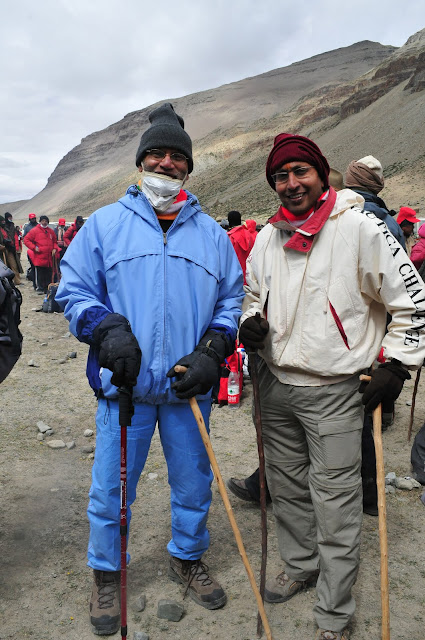 |
| Venkatarao-ji and Mallik, very humble super-trekkers |
 |
| The Tibetan porter administrator pulling names from a hat |
 |
| Kalpakkam-ji, Meera and Amma, and my young friend, Srihari :) who thinks I am not much older |
|
 |
| Waiting for a pony and porter, Rajeev has the strong and silent look |
 |
| I have a fantastic Sherpa guide, now waiting for a pony, chatting with a strong and silent listener |
Six years ago, the trek to Gaumukh - the glacier that feeds the river Ganga, was very treacherous, and we were trekking with a very chatty eight-year old - what if I fall into the river, mommy? what if I slip there, mommy? And yet, once the blue mountain Neelkanth was in sight, I had felt blessed that we will reach the glacier. Sitting on the ground, waiting for a pony, my jacket stuffed with wet wipes, paper napkins, medication, back-up camera batteries, candies and the like so that I could barely button it up, waiting to start the trek around Kailash, I felt the grace of Shiva - it was the same comforting sensation as in the presence of Nilkanth six years ago. And sure enough, the
trinetra - the three eyes of Shiva were upon us - see below.
 |
| Shiva watched the drama below, as we started the trek |
 |
| Yaks with the temperament of babies, waiting patiently to get loaded |
This is the first place I got to see the yaks up close. So far, I had seen some grazing on the grass, as the car rushed past. But now I see these sweet animals, patiently waiting to be loaded with unbelievably heavy loads that they will then carry up the mountains. In many blogs that I had read before coming to Tibet, the yaks were described as uncontrolled creatures, wild and unthinking. I have met people who were hurt quite badly, having been thrown off the yak's back as the yak ran up and down on the slopes. As the snake cannot be blamed for its
swadharma - biting, the bee for its sting, nor should the yak be blamed for its random movement.
The yaks are no longer used to carry Kailash trekkers in Tibet, but they carry the heavy loads that must go with the large groups. They reminded me of Snowy - patiently waiting for a tickle, no demands. It was a lost yak that caused a villager near the Line of Control in Kashmir to go searching at mountain heights and come across intruders from across the border building a bunker. He informed the Indian Army. The operation launched by the Indian Army went on to become the Kargill war of 1999 that India won at the cost of many young lives, full of promise.
Just as the people wait for their porter or their pony driver, the porters and pony drivers wait to be assigned a traveler.
 |
| Festive atmosphere as everyone waits for traveler-porter-pony-driver combinations to be sorted out |
There was a lottery for porters and pony drivers. For each person in line, the administrator put his hand in a hat and drew the name of the porter or the pony guy as the case may be. I got a white horse like I wanted - sinner from a past birth whose
prarabdha - destiny, it is to take my overweight self over the mountains. I walked 50 meters and got out of breath before realizing most people were already on pony, so I decided to get on the pony as well. All those miles of walking in Dallas were forgotten immediately as I settled comfortably on my sinner pony. I could take pictures, the pony ride was on flat land and the reason most people were not walking was that they were trying to conserve energy for the next day.
The porter lottery revealed interesting things. There are female porters, and the porter vary from age from adult to what I would call babies. Travelers need to be prepared to put up with the idea of young children carrying their backpacks. See picture below for Jayanthi's porter.
 |
| Little Jack Horner here is Jayanthi's porter, he was one tough kid |
 |
| On pony, for the first part of the trek |
We took a short pony ride for less than an hour, and then were asked to get off the ponies and have lunch while the ponies would eat and drink water from the stream.
And then again, a bit of a distance during which we got off the horses twice and walked short distances before climbing on, we were told to get off and walk the last half mile to the guest house at Deraphuk.
 |
| Getting off the ponies so they can eat and we can have our lunch too |
Kailash was visible most of the way as we did our clockwise parikrama around Kailash. There were clouds at the top.
An hour after we arrived at Deraphuk, Yoganand knocked on the door - the cloud cover had begun to lift, we would soon have photo ops. I wondered if he had any plans for
sanyas - renunciation. He appears to know all the prayers and chants, he has a very sweet, generally blissful disposition, he is close to all the Swamijis, besides having a brother who has taken sanyas already. No such plans, he assures me. Despite yesterday's brief glimpse into
sanyasi bliss, I am too attached to Ash and can feel the tearing pain for any mother if her child decides to take sanyas. I understand the
satsangatve nissangatvam... - from good company to solitude..., easy to memorize, difficult to live.
In the picture below, Yoga and I were watching Srihari make a video for his parents, while Rajeev in the far distance was walking to get a close-up picture. There is a 3-1/2 hour walk from Deraphuk to Charanapada - where one can go and touch Kailash's feet. The Swamijis had gone there after we reached Deraphuk, and came back late at night.
 |
| Yoga and Srihari watching the north face of Kailash, Rajeev on ground going for a close-up picture |
 |
| The stunning north face of Kailash, check out the cobra's hood at the top |
I stood outside with Yoga and Srihari for a very long time, watching the stunning mountain face - this is the view that brings you to your knees and acknowledge Kailash in all its glory.
The guest house rooms had attached bathrooms that were locked - the bathrooms may be construction in progress, and hopefully available for use next year. There were bathrooms at the end of the passage on each floor - you had to fill a bucket with water and take it in to flush the commode. And again the generator was switched on an off by a central controller - the flashlight headband came in very useful.
I had my soup and I was off to bed. The Sherpas were cooking dinner - what it was and who ate it shall remain a mystery because I fell asleep immediately.
Tomorrow is expected to be the toughest day of the trip.
Aum Namah Shivaaya!!


