"Full many a ray of purest ray serene the dark unfathomed caves of ocean bear:
Full many a flower is born to blush unseen, and waste its sweetness to the desert air."
from "Elegy Written in a Country Churchyard" by Thomas Gray
Showing posts with label Gujarat. Show all posts

Sunday, July 3, 2011

Dwadashajyotirlinga yatra : Day 9 - Dwarka, and travel to Kolkata

Early morning, we had a frightfully heavy breakfast buffet. Instead of gathiya, jalebi and fafda deep in the state of Gujarat, we had idlis and parathas. We had to rush to get the 7am darshan - viewing at the temple. This was a stretch, because we needed to drive to the airport in Jamnagar, 90 miles away, which could take up upto 3 hours. Despite the tight schedule, the Swamijis have decided to go to the temple of Dwarka. I am beyond joy, I would get to see Dwarkadhisha - the lord of Dwarka, after more than 30 years.   

Slightly more than five thousand years ago, the young Krishna killed the usurper of the throne of Mathura, his maternal uncle Kamsa, and re-instated the rightful king, Ugrasena, Krishna's maternal grandfather and Kamsa's father. Kamsa's father-in-law Jarasandha attacked Mathura seventeen times, and was warded off each time by Krishna and his elder brother Balarama. Krishna realized that Jarasandha would likely not stop exacting revenge as long as he lived. Krishna decided to move the people to Dwarka, an island with the Arabian Sea as its moat, thereby earning the title of Ranchhod - one who flees battle.

The city of Dwarka was a planned city, with considerable land reclaimed from the sea. The superior military powers and the leadership of Krishna and his elder brother Balarama brought the Vrishnis unparalleled wealth in gold and gems and cattle and horses. After Krishna left his mortal body, the island city of Dwarka was submerged in the sea, witnessed by his cousin Arjuna who came to Dwarka to take the women and children to safety, as described in Book XVI - Mausala Parva of the Mahabharata. Arjuna's elder brother Yudhishthira, the king of Hastinapur (currently in Delhi), made Vajranabha, Krishna's grandson, the king of Indraprastha (currently in Delhi). King Vajranabha had originally built the temple of Dwarka, dedicated to Krishna.

Recent advances in technology and geological and archaelogical finds provide scientific evidence to the stories from the scriptures. Gurudev has said - Faith is to believe what you do not see, the reward of which is that you see what you believe.

The current temple at Dwarka that we were about to visit, has five storeys, and was built in the sixteenth century with limestone and sand during the reign of the Mughal emperor, Akbar. The earlier shrine is believed to have been destroyed by Mahmud Begda, a Muslim invader in the fifteenth century.

Dwarka (or Dvaravati) is cited as one of the seven most holy spots for the followers of Sanatana Dharma to attain salvation, in the Garuda Purana, the others being Ayodhya, Mathura, Haridwar, Varanasi, Kanchi, Ujjain and Puri.
ayodhya mathura maya kashi kanchi avantika | puri dvaravati chaiva saptaita moshadayikah ||
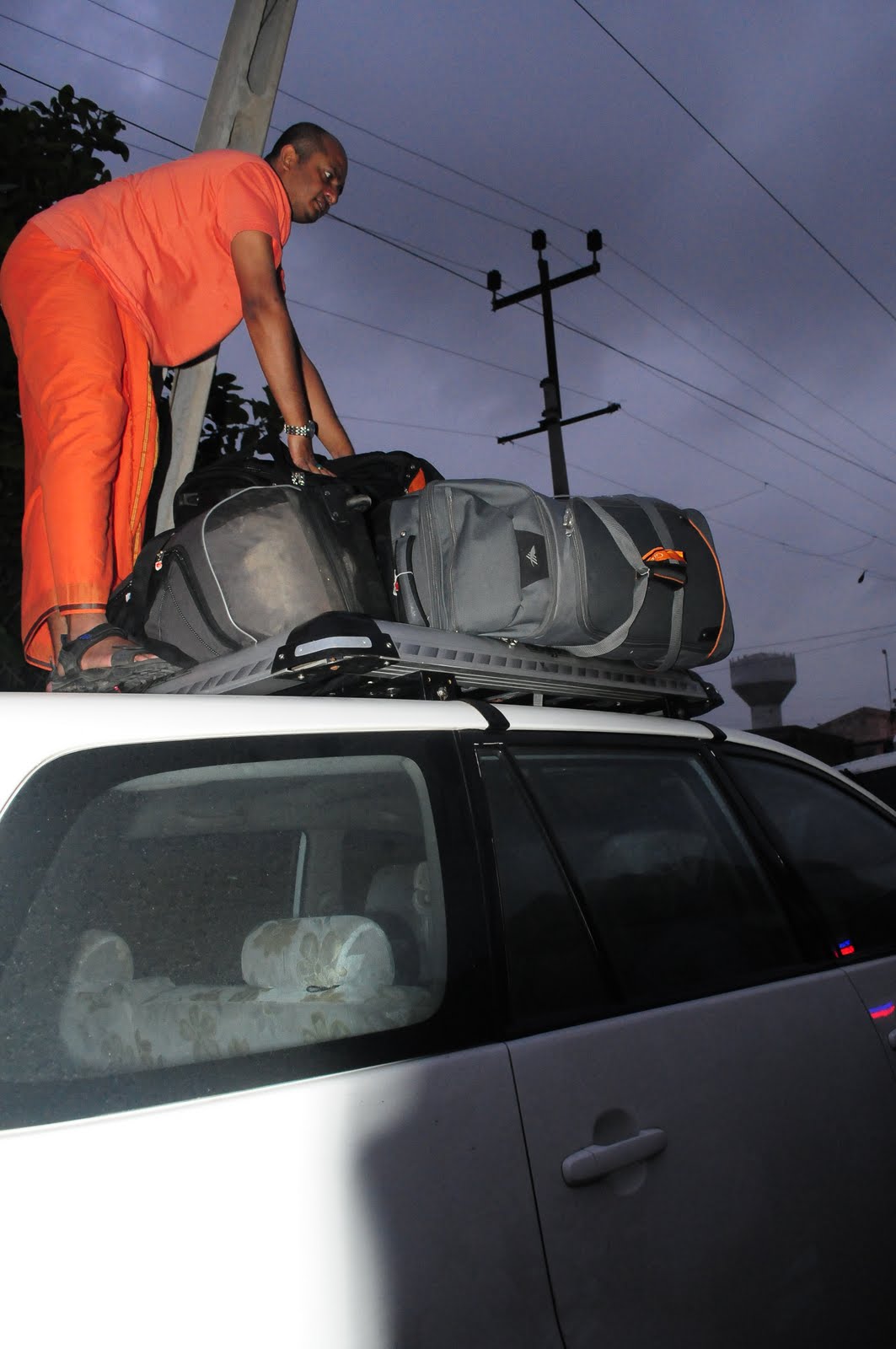
Packing to leave
It was a short drive to the Jagatmandir temple, where the deity is Dwarkadhisha - the lord of Dwarka, Krishna. I was eight years old when I came to Dwarka last time, and I clearly remember the little green picture frame with a passport-sized photograph of the deity that I had purchased for two rupees. It was among the first purchases of my life, and the memory of looking around at the store and settling for the little photoframe is always fresh in my mind. Ten years later, when a friend took me to Nathdwara in Rajasthan, I had bought an idol of Bal Gopal - the baby Krishna, and the paraphernalia to take care of the baby. And, I could clearly remember the morning years later, before my wedding, I accepted brahmasambandha - acceptance of Vaishnavism. Pushti Marg - the path of Grace, is a sect of Hinduism started in the sixteenth century by Vallabhacharya, a stalwart of the Bhakti Marg - the devotional path. For the ceremony, I had to wear new, unwashed, pure silk clothes and after a sprinkling of holy water and reciting a chant, I was given a tulasi mala - a chain with basil seeds to wear. 

For many years, I struggled with accepting Krishna as divine.I studied what he said by reading the Bhagwad Geeta, and Gurudev, Swami Chinmayanandaji's interpretation of the Bhagwad Geeta since my college days. I accepted Krishna as the Jagadguru - universal guru, the master of Yoga. But I stopped short at accepting his divinity. And with my intellectual pursuits of Vedantic concepts, I abandoned ritualistic practices for many years. It is my humble opinion that the daily worship of Bal Gopal - the child Krishna, the wearing of the tulasi mala, and other ritualistic practices only work to feed the ego, the I-ness, unless they are accompanied by true devotion that I just could not find within myself. It was only last year when Swami Shivayoganandaji had described how Krishna had visited Shiva's home, the higher Kailash during the Mahabharata, that the flickering memory of my Krishna worship from a decade ago, was revived.

Swami Sarveshanandaji's patience and guidance has gone a long way in my own spiritual search, and I have read texts and commentaries, and commentaries on commentaries, and gone to him with questions and doubts. Last year, I realized that I wanted to read devotional texts for which I had had no patience earlier. I started reading the Bhagwatam - the story of Krishna's life on earth, and a commentary on the Bhagwatam published by the Gita press, and somewhere along the way, I surrendered to Krishna. The ritualistic worship of Bal Gopal - the child Krishna, and wearing the tulasi mala came of its own accord. What Anantanandaji said to me on this trip on my internal struggle regarding Krishna, has stuck to me. My limited body-mind-intellect equipment can not comprehend Krishna's divine glory. So I should not try to understand Krishna from my perspective, I should surrender and look forward to experiencing his divinity.

The yellow silk sari that I had worn seventeen years ago to accept the Pushti Marg - the path of Grace, I wore again today to return to him. When I finally had a tulasi mala around my neck, and Krishna in my heart, I got the opportunity to visit the home of Krishna after more than thirty years.

Dwarka, at the westernmost point of the Indian mainland in the state of Gujarat, is known as one of the four dham - homes of Vishnu, the other three being Rameshwaram on the southern tip of the Indian peninsula in the state of Tamil Nadu, Puri in the east in the state of Orissa, and Badrinath in the north in the lower Himalayas in the state of Uttarakhand. Dwarka is also one of the four math - centers, the other three being Jyotirmath in the northern state of Uttarakhand, Shringeri in the southern state of Tamil Nadu, and Puri in the eastern state of Orissa, set up by Adi Shankaracharya who revived Sanatana Dharma from the depths of meaningless social and ritualistic practices to which it had fallen two thousand years ago.

Adi Shankaracharya traveled the whole country on foot at a very tender age, and revived hundreds of ancient temples, established worship rituals, and participated in academic debates with many scholars to make Advaita - non-dualism, as the dominant school of thought, and wrote scores of commentaries on texts and devotional hymns. In his short lifespan of thirty-two years, he re-established Sanatana Dharma as the mainstream faith in India. The guru parampara - guru tradition, of the Chinmaya Mission goes up to Adi Shankaracharya. Every temple I visit, every scripture or commentary I read, I am aware that I humbly follow in the footsteps of greatness.

We had to walk a quarter mile to the temple from the parking lot, barefoot. Fortunately, it was early in the morning, and the cold concrete now served to soothe my blistered swollen feet. There were gender-based lines in the temple, and very soon Ashverya and I found out that though the women from the villages may not be exposed to the complexities of urban life, they are tough cookies with devious ways of cutting in line.

Darshan - viewing, is challenging enough in a Shiva temple with the long lines, but in a Krishna temple, the temple schedule makes the timing crucial. Unlike Shiva, who once awakened, stays awake the whole day, Krishna wakes up, then gets ready, then takes a meal, then ... till he finally sleeps at the end of the day.  Between these many activities, the temple priests pull the drapes and decorate the deity and the sanctum sanctorum. The deity in a Krishna temple can only be seen at scheduled times, and the crowds keep milling and surging to see the newly decorated altar each time.

The pushing and pulling, and the arguments about who was where in the line may take away from the sanctity in a Shiva temple. In a Krishna temple, it sets the vibrant mood to match that of the presiding deity - I am quite sure he is extremely amused at the play around his temple. All the deities are different aspects of the one Almighty, with different personality traits attributed to each deity. And the charming Krishna of the twinkling eyes, likes to enjoy every moment. The deity at Dwarka is decorated luxuriously - in silk and with diamond-studded gold jewelry.

Once outside, I wanted to get some good pictures of the temple. Easier said than done, our car was nowhere to be seen. I walked a mile and asked the other drivers for our group, till I finally found our car, but our driver was missing. Half an hour later, our driver was still nowhere to be seen. Clearly, no pictures of the temple. Another time, another trip, Krishna's will...

As we waited for the driver to show up, a cow from a nearby group of idling cows, came and nuzzled Anantanandaji, who just stood there, exuding warmth. Then the cow turned to me. I held Sarveshanandaji's hand as the cow kept nuzzling me. This show of affection was amazing but scary at the same time - the cow did not have horns, but I was sure a nudge would be enough to throw me off-balance. I was precariously balanced on extremely swollen feet. The only other creature to shower me with so much love is my dog-child Snowy who is amazingly affectionate and can spend hours nuzzling and licking me and getting her stomach tickled. The cow started licking my hands, and I remember telling Sarveshanandaji - oh my god, she is licking me. He just nodded and kept smiling, while I held his hand tight. Just then our driver arrived, and we started getting into the car. At first the cow thought I was going to be in the front seat and tried to follow me there. As I climbed towards the back, she followed me there, and would have entered the car behind me. Suddenly, I was talking with the cow like I talk with Snowy: nahin, beta, vaapas jaao - No, child, you need to turn back. I said it a couple of times, and finally, like Snowy, she accepted. I had no idea cows licked people like dogs. Sarveshanandaji said cows used to lick Krishna's feet. I live and learn.

Dwarka
As we drove away, I got an unexpected good shot of the temple from afar. I would like to spend a few days here. Another trip, another time, Krishna's will...

The cars rushed off to the Jamnagar airport now, and arrived in good time. As usual, the Swamijis were in a great mood.


Apparently there is only one flight to Mumbai in the morning, and one return flight in the evening. We had to wait a while till the airport employees showed up and started checking in our bags.


The Swamijis were preparing to pelt Vinayakji when he entered the airport. I would have got the perfect picture but the security personnel suddenly saw my camera and told me photography was not allowed in the airport.


We flew from Jamnagar to Mumbai, where Dheeraj had arranged for packed lunches. Since we were forty-two people, we had to wait till the entire group was through with each step. We waited till everyone checked in, and found a seating area so most of us could sit down. Then started the process of opening three cartons of packed lunches and handing out to each person. Again, the organizational skills of the Swamijis is the only reason such trips materialize as planned.


Jyotiji's friends had given her a bouquet of flowers that entertained us for the time we spent eating lunch.


After the flight from Mumbai to Kolkata, the short bus journey in Kolkata from the airport to the bus was spent sleeping. When we arrived at the hotel, there was a lot of music like a grand celebration was about to happen. What it was, I will never find out because the moment a room was assigned, we trooped upstairs to quickly freshen up and come downstairs for dinner. We had travelled from Jamnagar to Kolkata, a land distance of just slightly more than 1100 miles. As we sat for dinner, it had been sixteen hours since we woke up in Dwarka, much of which we had spent in travel by car, plane and bus.

The dinner spread was fantastic as usual. The last thought as I set my tired body down to sleep was that on this date last year, we had been blessed with a view of the northern face of Kailash, and when I had gone to sleep, my last thought had been that the next day was the most difficult day of the Kailash trek.

Tomorrow, we have a long drive to Dhanbad - my first visit to Bihar and Jharkhand.  

Aum Namaha Shivaaya!!

Saturday, July 2, 2011

Dwadashajyotirlinga yatra : Day 8 - Somnath and Nageshwar

1 year ago, on this day, at this time, I was standing in Tibet on the shores of the lake Manas Sarovar. After the Swamijis had performed the morning yagna - worship ritual facing Kailash, the cloud cover had lifted and we had our first darshan - viewing of Mount Kailash, my Shiva's home on earth. 

Today, we left Rajkot after breakfast at 6:30 am, and headed to Veraval. Being in the car with Sarveshanandaji and Anantanandaji was an immense blessing. And I knew Ashverya felt equally blessed – she was in a car with the other two children and her favorite auntys – Natana and Ratna, both of whom radiate warmth and affection. I already knew Madhukarji but this car trip was my first chance to get to know Rameshji, the most saintly non-saint I have ever met - down-to-earth and simple and virtuous. My practical worldly persona saluted the purity of his spirit. There are many things in life that I characterize as experiments or experiences that I am sure everyone went through as they grew up in the same years as I did, but it was wonderful to find someone untouched by temptation. 

Saintly non-saint
Passing through the streets of Rajkot, a town filled with my childhood memories from more than thirty years ago, I tried to find a familiar sight. But other than being able to read the signboards in Gujarati, there was not much I could identify with. The one sign that we all loved was the one before each bridge – counter-intuitive but very scientific - Attention. The Bridge is Weak. Drive Slowly. It is a Single Lane Road. The question arises - why is every bridge weak? 

Drive Slowly, The Bridge is Weak
I longed to eat a Kathiawadi thali - a meal of the local cuisine, or at least stop at a chai place that serves it so I could smell the flavors of my childhood and take pictures. But this was not part of the plan. Another trip, another time, Shiva's will... 

I dozed off and when I woke up, we had already passed the town of Virpur. So I missed seeing one more thing on my list of things to look out for - a passing glimpse of the Jalaram Bapa temple, that feeds the entire village and visitors three meals every day. Since 2001, the temple has stopped accepting donations because the temple trust is flush with funds. Jalaram Bapa was born in 1799 in Gujarat, and though he was married off at a very early age, his vocation in life was to serve society. He refused to join the family business, and instead started a sadavrata – a free eating place with his wife, that ran on private charity. That effort has grown into the current temple trust. One of the things I love about this village is the maintenance of concrete tanks for animals to drink water from. It is common in India to find free drinking water for people in public locations, paid for by private donations. But this is the only place I have seen a free fresh water supply for animals.
 
The driver was driving exactly at the speed limit, and many times, Anantanandaji asked him if he should take the wheel so we could reach Somnath sooner. It turned out that the car in front of us was driven by the person who owned all the taxis we had rented. And none of the drivers were allowed to overtake him, they were to follow him. Basically, he decided the route, the stops and the speed. And much to our amusement, as the Swamijis incited him to overtake his boss, the driver stayed mindful of his job and maintained his speed and position.
Driving from Rajikot to Somnath, the road became beautiful as we got closer to the coast. On the left, is Mount Girnar, one more thing I missed because I dozed off. The forest of Sasan Gir around this mountain is unique as the only place in the world where the indigenous population of lions is growing, a tribute to the hard-working people in the forest service, like Madhukarji's dad who dedicated their lives to protecting the natural environment. As we got closer to the town of Veraval, there were beautiful cocounut palm plantations. The sight of palm trees always fills the heart with joy because of the associated memories of sun and surf. Prabhas Patan was now very close.


The temple of Somnath is in Prabhas Patan, now also known as Somnath Patan, now a part of the town of Veraval, but described in ancient scriptures as a town in its own right. Krishna was often in Prabhas, and ultimately left his mortal body at a spot now known as Bhalka, a mile away from the temple of Somnath. There is a beautiful temple in Bhalka with lifesize statues to depict the scene of the hunter Jara, mistaking Krishna for a deer and shooting his foot. Bhalka is located at the confluence of three rivers - Hiranya, Saraswati and Kapila, and the banks at the confluence are known as Triveni ghat - bank, a popular site for pitaratarpan - offerings to ancestors. It is usual to see people taking a dip here. Dehotsarg at the Triveni ghats is believed to be the place Krishna's mortal remains were cremated, five thousand years ago. The nearby Geeta Mandir is a beautiful small temple in marble with the Bhagwad Geeta in its entirety carved on the temple walls. Also close by, is Dauji-ki-gufa - Brother's Cave, where Krishna's elder brother Balram was last seen leaving for the banks of the Saraswati. Adjacent to it is a Shiva temple. The compound that hosts these various temples takes all of half an hour to visit, but again this was not a part of our schedule on this trip. Another trip, another time, Shiva's will...


Terrorist threats from Islamist extremists to the very existence of the temple of Somnath has resulted in a cordon of police security, and devotees having to park cars a long distance away and walking to the temple. Once the cars stopped at a parking lot, Swamiji asked us to leave our footwear in the car. This soon turned into kathor tapas - severe penance, because the road was unbearably hot in the summer. Sometimes I wonder how my has more resilience to the heat in India than I do. The heat, the burning pain on the soles of my swollen feet, and walking barefoot through pebbles tested my endurance severely.

As I walked towards the temple, the chant of Aum Namaha Shivaaya in my head, I wished we had reached earlier to perform the abhishek - annointment of the lingam at Somnath. To me, Shiva resides as a strong benevolent presence at Somnath, and every moment spent in the temple premises is a celebration. As we walked into the temple, we heard the beating of drums and clanging of bells and the chanting - it was time for the noon aarti - worship ritual with lamps. Could we get any luckier? The temple at Somnath has three times for the aarti of the deity - early morning, noon and late evening. When we entered the temple, the lingam had already been decorated, and we got to see the last portion of the worship. After the worship in the sanctum sanctorum, the priest walked around the temple with the lamps, four security guards following him closely. Four years ago, when I had visited Somnath within a week of the bomb blasts in Ahmedabad, security at the temple had been extremely tight. It was humiliating and physically painful to see armed military men in uniform surrounding the priest as he performed the worship ceremony. There is not only a standing threat to the existence of this temple but also mortal threats to the priests. I knew the security people wore shoes because they needed to be combat-ready at all times. And yet, then and at any time that I have thought about it, it brings tears to my eyes.  

The temple of Somnath has stood the ravages of time. The legend goes that Chandra, the Moon, favored one of his twenty-seven wives, who were all sisters. Their father, Daksha Prajapati warned Chandra to treat all his daughters equally. Chandra continued to favor Rohini, and the enraged father cursed the moon to lose his vitality. Chandra then prayed to Shiva who appeared to him, pleased by his devotion and partially reverted the curse. The Moon thus loses its vitality over two weeks, and regains it over two weeks. The grateful Chandra built the temple in Shiva's glory, Somanath - the lord of the Moon.


In more recent times, the temple was built in the seventh century by the Vallabhi kings of Gujarat. This was destroyed by the Arab governor of Sindh in the eighth century, and then the third temple was built by Nagabhatt, of the Pratihara dynasty in Gujarat. This was destroyed in the eleventh century by the invader Mahmud Ghazni from Afghanistan. The fourth temple was built by the kings of Gujarat that was destroyed by the Turk-Afghan Allaudin Khilji in the thirteenth century, who killed thousands and maimed thousands more, and enslaved thousands. The temple was again rebuilt by the kings of Gujarat, but later the kingdom of Gujarat itself fell into the hands of Muslim invaders who became rulers and raided the temple for its riches in the fourteenth and fifteenth centuries - the temple had a dome of gold, encrusted with rubies and gems. Somnath was rebuilt each time by the Hindu populace. In the early eighteenth century, it was destroyed by the Mughal king Aurangzeb who had destroyed hundreds of Hindu temples all over India, and converted them to mosques and mausoleums. But in the late eighteenth century, the queen Ahilyabai Holkar of Indore rebuilt the temple, and also built another Somnath temple where I had performed abhishek - annointment four years ago. 

In the mid-ninteenth century, the British army in Afghanistan uprooted the gates of the tomb of the invader Mahmud Ghazni, because they were rumored to be the original gates of the Somnath temple. When brought back to India and examined by experts, they were found to be replicas and were placed in Agra Fort in the southern part of the Khas Mahal, where they can be seen to this day. The Sikh army who had fought with Ghazni when he was returning to Afghanistan with his spoils via Punjab, had got the sacred temple gates back. There is a controversy why the priests at Somnath did not take them back - either the temple was in ruins already, or because they did not want temple gates that Muslim invaders had kept in their possession. Either way, the ruling family of Punjab installed them in the Golden Temple at Amritsar, another place I will visit one day.   

After India became independent in 1947 from colonial British rule, Vallabhbhai Patel, the Deputy Prime Minister of newly independent India, visited Somnath, and was apalled at the state of this glorious temple. Along with a few others, he got the blessings of Mahatma Gandhi to get the temple renovated. A private trust was set up, and President Rajendra Prasad, an ardent devotee as well, performed the installation ceremony of the temple in May 1951. This created a serious conflict with the Prime Minister Jawaharlal Nehru who took this as a gesture of Hindu revivalism, a trait that seems to be inherited by the branch of the Nehru family that does not seem to be able to let go Indian politics. The history of the renovation of the temple in the twentieth century has been captured in photographs that can be seen in a little museum in an alcove to the right as one enters the temple. Behind the temple of Somnath lies in ruins the temple of Parvati, Shiva's consort. The state of those ruins bring to mind what the state of Somnath must have been, before the renovation.

The temple of Somnath is on the shore of the Arabian sea, the only sea shore I knew in childhood. There is no land mass between the temple and the South Pole, and there is a marker by the temple that shows the direction of the South Pole. After three parikramas - circumambulations around the exquisitely carved temple, the chant of Aum Namaha Shivaaya in my head, we sat down as a group on the temple steps. One of the new things I noticed this time was a display that describes the 12 jyotirlinga temples. My camera was left behind in the car, it would not pass the security check at the gates of the temple compound. Every sight had to be allowed to sink in and memorized for posterity. 

Anantanandaji walked out of the temple, "walking like a car" as Ashverya describes his walking speed. Along with a few others, we hobbled behind him as fast as we could, yelling at every burning sensation as we walked over the heated concrete. Behind the Shiva temple built by Ahilyabai Holkar that we would visit next, there was a store selling cold drinks - cardamom-flavored and saffron-flavored milk shakes, perfect in the hot summer. We waited for the rest of the group to follow, but we could see them getting group pictures in the temple complex. The security arrangements at Hindu temples have given rise to a new job, the official temple photographer, who is the only person roaming the premises with photography equipment and making a load of money taking digital pictures and printing color copies.

A little boy came by, selling grains to feed the pigeons, which was when I noticed hundred of pigeons pecking away on the ground. Vinayakji, one of the gentlest souls I have ever met, took Ashverya with him to feed the pigeons. She has been learning the ways of India - early morning, people stop on the streets to buy cattlefeed from vendors on bicycles, to feed the cattle. And for many people, it is a ritual to feed the birds every morning. By now, the entire group had gathered and we had our fair share of cold drinks to cool us down. Next, we visited the Ahilyabai Holkar temple, where we could touch our heads to the lingam.      

Now we began our long walk to the car. I could have sworn the soles of my swollen feet had burns, and now we were walking through burning hot sands and then burning hot concrete. At some point, the body was sending so many 911 messages that the brain refused to take in any more input on pain. It is strange how easy it is to chant Aum Namaha Shivaaya in comfort, but with the sensation of burning flesh, the mind had to struggle desperately to cling to Shiva's name. As I was about to sit, the driver said - No, No, No. And like a flash, without a thought, I said - Don't fry my brain, let me sit. Even as I said it, I knew I should not be saying it with such vehemence. Just a moment later, the weight off my burned swollen feet, I turned to ask him what he wanted. He wanted me to wait for Madhukarji and Rameshji to reach the car because they needed to climb to the back of the car. My flash of irritation had died as soon as it had risen, but it had risen and been expressed, and that needed to be taken care of. I got out of the car, and after we had all settled in our seats, we were off for lunch.

We drove about fifteen minutes away to a place that I am sure could have served great traditional Kathiawadi fare, but we were served the same generic meal that Dheeraj has ordered at every place, the menu of least resistance that satisfies all palates. I had my rice and plain yogurt again. Anantanandaji asked the restaurant to warm some oil so I could massage the soles of my feet. As I applied the oil, I realized that there was no sensation in some spots, and there were some bumps, I actually had blisters on my feet. 

I dozed off in the car again, and only woke up when the car stopped. We were at the shore, all the cars had stopped. I waded into the Arabian Sea after more than thirty years. Almost immediately, it was time to leave, this had been an unscheduled stop. I took some pictures, and we trooped back into the car. I did not see Ashverya, she must have been sleeping soundly in her car. Like me, my child catches all the sleep she can, without a worry in the world.

Arabian Sea, on way to Dwarka from Somnath

Arabian Sea


After a chance view of the ocean, I was wide awake on the road to Dwarka. We wanted to stop for chai, but there was nothing on the way, it is a long road. I cannot be sufficiently grateful for being in the car with Swamijis who live every moment. There is not a single dull moment. Sarveshanandaji acts miffed that I would not put my feet up, but my legs could be close to being amputated and I would still not think of putting them up in front of the Swamijis.

Finally, close to Dwarka, the cars turned into a dhaba - eating place, for much needed chai and coffee and restrooms.


It was past sunset when we reached Nageshwar - two jyotirlinga in one day, the day could not get any better.


Outside the temple, there was a gigantic statue of Shiva, glowing complexion and golden hair. Closer scrutiny revealed that there were many peacocks stting on the statue. This was installed by the music producer Gulshan Kumar who created a business of devotional music and gave an opportunity to hundreds of struggling singers to create music records.

Nageshwar (Jyotirlinga #9)
When we entered the temple, the priests were gearing up for the evening aarti - worship ceremony with lamps. There was a huge display of things for purchase as we moved towards the sanctum sanctorum, and that delayed our group quite a bit because we have not had time to shop on this trip - not just for themselves, but even to get momentos to carry back. On this trip, I appreciated this lack of time because I have a propensity to collect things, and the more time I am given, the more likely I am to buy things that I may not look at again, after bringing them home. Vinayakji asked the children to picks life. a souvenir they liked, and he would pay for them. Ashverya picked a little turtle in stone - it is such a blessing to have a child in one's life, there are all these awwww.... moments.

The temple of Nageshwar is very modern. Either I am very tired, or just not tuned in, but it did not feel that I was standing in a powerful Shiva temple. We sat in a circle, and Swami Anantanandaji started chanting. The vigorous rhythm of chanting always creates purifying vibrations. Soon the clanging of the bells, and the beating of cymbals and drums and the chanting and the singing and the circular motion of the lamps created the familiar atmosphere - invoking Shiva, but somehow, somewhere, there was something missing for me at this temple. After the aarti - the worship with lamps, we were allowed to go into the sanctum sanctorum in groups of five, I think, and touch the lingam. I had thought, at last I would experience Shiva's potent presence, but I did not experience anything more than my own devotion for any place linked to Shiva. Perhaps another time, another trip, Shiva's will... 

The jyotirlinga of Nageshwar is described as "...darukavane Nageshwar..." - Nageshwar in the Daruka forest. This could easily be misinterpreted as Dwarka forest, but neither there is a forest at Dwarka, nor do the scriptures mention any powerful shrine near Dwarka. The temple of Nageshwar itself was a revelation to me a year ago, when a friend of mine mentioned it. There is the temple of Jageshwar in Almora in the Himalayan state of Uttarakhand, where deodar trees (pronounced deva-daar in Hindi) are abundant, and there is a possibly that a deodar forest is referred to. Jageshwar is now on my list of temples to visit to worship Shiva, and every spot he sanctified on earth.

We performed the parikrama - circumambulation of the temple. It was a very clean and quiet place. On another day, I could sit here for hours but for now, we had to drive to mainland Dwarka, about an hour away. From there, one can take a ferry to Bet Dwarka, the island town, a tiny remnant of the huge island kingdom built by Krishna, the king-maker. We would not be going to Bet Dwarka. Another trip, another time, Krishna's will...


We reached Dwarka around 9 at night. It was a very small hotel, not at all the luxury places we were used to finding on this trip. It is amazing to me that Vishnu's poorna avatara - the complete incarnation, Krishna did not bless his city with eternal prosperity. Dwarka remains a small town, dependent on earnings from visitors who are mainly Krishna devotees. Some of us would have rooms here, the others would have rooms in another hotel. For now, we quickly ate in the small restaurant space. I got my usual plain rice and plain yogurt. When our rooms were assigned, it was a relief that the sparse and cheap furnishing aside, the room was clean and cooled down quickly.  

After the rooms had been assigned and bags sent to rooms, I went for a walk with Anantanandaji on the streets of Dwarka, and I would have loved to walk till the ocean, and sit on the rocks. For once, he spoke to me about the Vishnu tattwa - the element for earthly success. So far, he had been telling me about the Shiva tattwa - the element for spiritual growth. We had a travel schedule to follow, so the walk had to be cut short on that market street. But now I understand the ashram system, and why children were sent to live with the guru and learn for the first twenty-five years of their life. There is so much to be absorbed and imbibed from a guru that can only be received by complete surrender. We are so used to time-constrained sessions in lecture halls with formatted presentations and a question hour, that it is refreshing to keep the mind open and alert, and listen to Anantanandaji for as much time as he gives me.    

Tomorrow, 7am visit to the temple at Dwarka, therefore 6:00 am breakfast, therefore 5:00 am morning alarm!!

Aum Namaha Shivaaya!!