BACK IN DELHI - MATRABHOOMI JANMABHOOMI BHARAT, SARZAMEEN-E-HIND, MY BIRTHPLACE INDIA, AGAIN!!!
We were asked to put our bags outside the room before 6, and leave at 6:30 am to the airport.
The bag pick-up person could only take one of my bags, story of my life. Anyway, I wheeled the other one to the reception counter. As usual, there were three persons from the travel agency who stood and stared but nobody bothered to offer support or service. When I asked the hotel reception guy what I was supposed to do with a bag I have dragged from my room, he rushed out to talk to them and finally I found out that my second bag needed to just sit there outside the hotel and wait to be loaded. Why??? And where was the bag they picked up from my room???
When I came back after breakfast, the second bag was still sitting outside, the first bag still nowhere to be seen. People did not know where their bags were, and Swarn announced that they would check the rooms to make sure everything is picked up. This incomplete logic was infuriating, especially in light of yesterday's chaos. I had to put in my tuppence again - I was not going to budge till I saw the first bag that had apparently been loaded since it is nowhere to be seen but nobody could confirm that - there is no clear handshake, and I did want to see my second bag get loaded before I boarded a bus for the airport. Why is service not given till the customer asks for it??? A couple of others like Sriniji said too that they needed to see their bags before boarding the bus. Shrestha people pulled the bags they had loaded for the passengers to make a visual check. Luckily my first bag was there, and the second one was now loaded into a car, and we were off to the airport.
Another round of chaos at the airport as people unloaded any bag from any car/bus and put in any cart and started pushing. My gigantic military green bags stand apart and I was able to put them in a cart and start pushing. Within fifteen minutes, there were people going crazy because they didn't know whose bag they had and they didn't know where their bags were, and someone had put their Manas Sarovar jal - water, in their carry-on luggage, etc etc. The security at the door checked my passport and said, Neeraja-ji, aap Kailash gaye the? - Did you go to Kailash? The "apnewale" pyaar - love for "my own people", had started again, this time from the Nepali officers and staff. The security guard at the escalator was warm and affectionate and all this stopped when I reached the Jet Airways ticket counter and the lady wanted 5000 Nepali rupees for the extra weight in my bags. This was when I realized the people at Delhi had let me travel with the additional weight. So 5000 Nepali rupees it was to get to the next step.
Off to the pretty invasive manual physical check and then the manual hand luggage check where the security woman pulled out all my camera equipment and started counting all my currency from Nepal, India, China and the US. I had to admit it looks pretty fishy to be carrying so much photography equipment and cash in so many currencies but her supervisor who came running over to inspect the proceedings was very friendly. He suggested I should have said I was Nepali to avoid all this pareshani - problems, and told the security lady to put everything back. He said I looked Nepali, nobody would question me if I said I was one. The final check before heading off to the plane, and the very final check on the plane just before entering - again warm and friendly people wondering if I am Nepali and finally, I got to sit in the plane.
The hospitality of Indian carriers is legendary in this day and age. Already, we had water and juice while the plane was on the ground, and now free beer!!! This is Shiva's brand of humor - free alcohol was being served when there were six Swamijis on the plane, and everyone down the aisle modestly refusing to drink. Luckily I can look at beer without temptation. Besides, I had stopped taking any alcohol in April because of my gratitude at getting the chance of going to Kailash,
Finally, I was back in Delhi - matrabhoomi janmabhoomi Bharat, sarzameen-e-Hind - motherland India again!!! The immigration officer squinted at me a few times but then smiled and let me go - I was entering the country for the third time within six months, - I am glad the immigration officers stay on top of these things.
My bags came fairly quickly. A successful two-week trip and four days of sheer joy sealed with a hug and a kiss - don't know if we will ever meet again, and many Namaskars and Pranams and Hari Oms later, I was out of the airport into the hot and humid Delhi air, going to Jyoti's to unpack and pack some more for my 36-hour visit to Haldwani by train. And then unpack and pack again for Ahmedabad.
Soon, it will be time to return to my karmabhoomi - land of action, America where the immigration officer will squint at me quite a bit and ask me where I have been and why, and take my picture and fingerprints for the third time this year, before welcoming me home.
Aum Namah Shivaaya!!
Showing posts with label Kathmandu. Show all posts
Showing posts with label Kathmandu. Show all posts
Saturday, July 10, 2010

Friday, July 9, 2010
Kailash 2010 Day 15 : Back at Kathmandu, Friday July 09, 2010
We started at 7 from Nyalam, and weaved through the mountainside to reach the Chinese immigration office by 8:30 am. The processing started at 10 am and again we were on Friendship Bridge, this time walking to Nepal.
The road from the bridge to the buses waiting for us in Nepal is all downhill. In the crowd of people - our group and many others, Mallik appeared by my side to accompany me till the bus - my perfect bade bhaiya - elder brother, making sure I don't need a porter, and that I don't need any help from him carrying my two backpacks.
When we reached the buses, we realized there were only two buses with a capacity of thirty each, not enough for a group of 71 with 10 sherpas. An hour and a half long chaos later, we finally have three buses.
The Nepal countryside is more beautiful than I remember from the bus journey two weeks ago.
The buses ambled along till we were stopped suddenly on a village street. The locals were protesting some police action and had created a road barrier. Swarn called the police so that the barriers could be lifted, citing
several sick people on the bus.
Things happen for a reason - in the one hour that we stopped on the road, I got an introductory class on marijuana from Seeta Devi. Apparently, it grows in abandon in the Nepal countryside, and the good doctor recognized it. I thought those were tomato plants. I am a bit concerned the buffalo may be high.
There were Kodak moments of the animal kingdom by the plenty - buffalo chewing the cud, a bunch of ducks on a walk, a goat chewing on grass, dogs lazing in the shade, a rooster strutting around, sweet thin cows walking along looking like they need food and exercise to develop some muscle,... Once the police arrived, it did not take long for the road to clear up and we went off to Kathmandu.
Swarn told me bungy jumping was out since it is 4km away from the place she had planned lunch at. We passed the bungy bridge without stopping - I will need to come back another time.
The Borderlands resort had beautiful planned gardens that opened into each other, with a thatched-roof patio as the dining place.
The dinner tables were Lebanese style - low lying tables with cushions as seats. The food looked good but other than my aloo-paratha binge and the one-time dessert of kheer at Nyalam, I was still on steamed rice and two spoons of dal water. The place felt like a luau, the only thing missing were the Hula dancers.
The world is beautiful when the heart is happy.
The resort had scenic viewpoints like the upper area at Yellowstone. The river gurgles and flows at a remarkable speed around the resort.
Alka had taken the altitude pretty badly, I saw her smiling today after a long time. Sairam was feeling much better as well, everyone is much happier now that we are close to the end.
As usual, Seema had found a way for us to go touch the water, and just about the time that we reached the river, we heard the ear-shattering whistles from Rajeev and Yogananda, and like trained dogs, we obediently turn to leave. Rajeev and Yoga have been given these whistles since we entered Tibet to herd up the people, I think they have enjoyed the whistling way too much.
The driver took his own time to reach the hotel. Our youngest and sweetest traveler by far, Varsha asked me riddles in the bus - I have to confess I did not get a single one.
The driver appeared to like driving, and despite the delays we had encountered already, he took a long circuitous route once we entered Kathmandu. What was expected to be a five-hour journey took eight hours and there were cheers when the bus finally reached the hotel gates. I am quite sure the sarcasm was lost on the driver. The extra time was well used in my bus for some chanting - the energetic rendering of the Mahishasura Mardini stotram that I love to hear and only know one line of :), and some others that I faintly recognize or not at all - I grew up in the same country learning only the Catholic prayers said at school. To this day, the only complete prayer I know is the Lord's Prayer that I say at any temple, shrine or deity. Now, having gone through the challenge of trying to memorize Sanskrit stotrams as an adult, I recommend the memorization of Sanskrit with accuracy in recitation from childhood. I am amazed by my friends from Andhra who recite gazillion lines in Sanskrit without having to look at a book. I have been given a second chance in life for learning, not everyone gets that opportunity.
The eight-hour journey cramped in a bus seat had turned my legs into balloon art - I did not have ankles anymore, my legs were swollen into tubes. My Manas Sarovar jal was lost - I had forgotten the containers in my room at Chiu Gompa, it was handed to Swarn and that was the last anyone ever saw them. Repeated reminders in the last three days had borne no result, I had been told the cars would be searched, the Sherpas would be asked, the truck would be searched, nothing had happened yet. The cars were already gone when we crossed the border in Tibet, the truck would leave if not checked quickly at Kathmandu, and tomorrow morning we would be in Delhi. Instead of an apology for losing my things, I was being told that I can go buy a can from the market and Shrestha can give me some of the additional Manas Sarovar jal. This is the last straw. I hate to do this at the end of a satisfying journey, but I had to articulate that I was a paying customer, and I would like Shrestha to make things happen, the jal needed to be delivered to me in a way that I can carry it to Delhi.
When we arrived at the hotel, chaos reigned again, no surprise!!! Some duffel bags were lying on the grass. We were told they would be delivered to the rooms. At the rooms, we found more duffel bags strewn in the grass and it has now started drizzling. My bag was not outside the room, it must still be lying in the grass outside the hotel reception. When I walked back there, there are four people from Shrestha to stand and stare. The hotel manager was talking incessantly into his mobile without any progress on the bag situation. A couple of hotel employees were now bringing the wet bags from the grass to a covered area. I saw my bag now, and asked the manager to have it delivered to my room and give him the number, and finally walked back in the rain on my swollen feet to shower and change for the final meeting at 8pm. At the room again, and no bag. I walked back to the reception counter, now my bag was not there either though it had not been delivered to my room. When I asked the manager where the bags had gone, he told me they were delivered which I assured him mine was not. He told me to go check again. Time again for my second speech today on "let me remind you who the paying customer is" but the hotel manager was too busy on his mobile. When he got free from his many conversations, I told him my luggage tags (for my international bags stored in the hotel) were in my duffel bag which I have not received yet, so how do I get my bags back because it was time to start packing for Delhi now. The answer is not "we will need a photo ID" or "please come back at 8 so we can take you to identify your bags" etc. It is "you will have to wait". All rightey then, time to throw a hissing fit about the hotel's service standards and the lack of basic common sense as well as the apathy of the Shrestha onlookers while customers run from pillar to post searching for their bags, most of which are now wet in the rain. The emotional feedback got due attention that soft-spoken queries were not getting, and I was off in a car with a hotel employee towards the rooms to search for my duffel bag.
The question arises why do service providers wait for the customer to be irate before providing basic services??? Why does the decibel level need to be high for us to act??? CRM 101 needs to be a mandatory course in all schools and colleges globally so that we get service of a consistent quality anywhere we go. If the manager had apologized that I had to walk between buildings twice just to ask about my bags, and that he would make sure my bag reached my room, I would have walked back to my room for the third time without kicking up a fuss. We found the bags in a common area, completely wet - it was dumped in the heap of unclaimed wet bags outside the guest building even though it was raining and the dumper should have known better and the dumper was the hotel employee to whom the room number was given very clearly. I explained to the hotel people that if my clothes inside were wet, they would be ironing them all night so I can leave for Delhi in the morning. Of course, my belongings are dry as the desert air, I had packed everything in sealed ziploc bags. I now walked back on my swollen feet one last time to give my luggage tags to the hotel reception to get my international bags.
Rajeev did a great job as the MC for the 8 pm meeting to express our thanks to the gurus, inviting some people to share their experiences. Throughout our trip, at each new place, as we dragged our aching bodies and our bags from our cars, Rajeev would have figured out room allotment and would be announcing it cheerfully. Not sure we thanked him enough. With Bose, Srihari, Yogananda, Rajeev and others, I think the Swamijis chose the perfect volunteers from the group to do the most tedious tasks in a spirit of service. A lady who described Swami Shivayogananda's advice to her before trekking around Kailash gave a very modest and humble and honest close-to-the-heart speech that spoke to me.
I could not believe this was over, I did not think I got enough time with the Masters, I did not think I learned as much as I should have, I did not feel I had experienced enough to change much, I could only hope the spiritual experience of this trip stays with me and reveals itself over the years. No amount of guru dakshina - offering to the guru, can correctly represent my gratitude for what the Swamijis have done for the group - leading us to Kailash and Manas Sarovar, chanting stotrams that I am now inspired to learn, the satsang - discourses that I can never get enough of, and even the bhajans - hymns that, ahem... help me relax. And they have gone beyond the role of acharya - spiritual leaders, and taken on the organization and detailed planning for this trek and they have been directly accessible as the main contact persons for any issue or question.
Swarn handed out certificates for the Kailash - Manas Sarovar trek for the group. AND, delivered Manas Sarovar jal for me, I had something to take back now. Many people had by now offered to share their jal with me if I did not get anything. One more reason to go with a harmonious group like the Chinmaya Mission group for such treks.
And dinner had sugarless yogurt alongside the pre-sweetened yogurt. Finally!!!!
It took two hours to pack everything into my international bags and they are well over the 20kg limit of Jet Airways.
Ab Dilli Door Nahin - Delhi is not far now.
Aum Namah Shivaaya!!
 |
| Waiting for bus no. 3 |
When we reached the buses, we realized there were only two buses with a capacity of thirty each, not enough for a group of 71 with 10 sherpas. An hour and a half long chaos later, we finally have three buses.
The Nepal countryside is more beautiful than I remember from the bus journey two weeks ago.
The buses ambled along till we were stopped suddenly on a village street. The locals were protesting some police action and had created a road barrier. Swarn called the police so that the barriers could be lifted, citing
several sick people on the bus.
 |
| I am very concerned that buffalo behind the marijuana plant is high |
Things happen for a reason - in the one hour that we stopped on the road, I got an introductory class on marijuana from Seeta Devi. Apparently, it grows in abandon in the Nepal countryside, and the good doctor recognized it. I thought those were tomato plants. I am a bit concerned the buffalo may be high.
There were Kodak moments of the animal kingdom by the plenty - buffalo chewing the cud, a bunch of ducks on a walk, a goat chewing on grass, dogs lazing in the shade, a rooster strutting around, sweet thin cows walking along looking like they need food and exercise to develop some muscle,... Once the police arrived, it did not take long for the road to clear up and we went off to Kathmandu.
 |
| Took me back to my Dallas neighborhood where we come to a screeching halt to let ducks cross the street |

 |
| Borderland Resort, Nepal border |

The Borderlands resort had beautiful planned gardens that opened into each other, with a thatched-roof patio as the dining place.
The dinner tables were Lebanese style - low lying tables with cushions as seats. The food looked good but other than my aloo-paratha binge and the one-time dessert of kheer at Nyalam, I was still on steamed rice and two spoons of dal water. The place felt like a luau, the only thing missing were the Hula dancers.
The world is beautiful when the heart is happy.
The resort had scenic viewpoints like the upper area at Yellowstone. The river gurgles and flows at a remarkable speed around the resort.
 |
| Water at high speed around rocks, Borderland Resort, Nepal border |

 |
| KV Rao |

 |
| Mallik missing Aparna |

 |
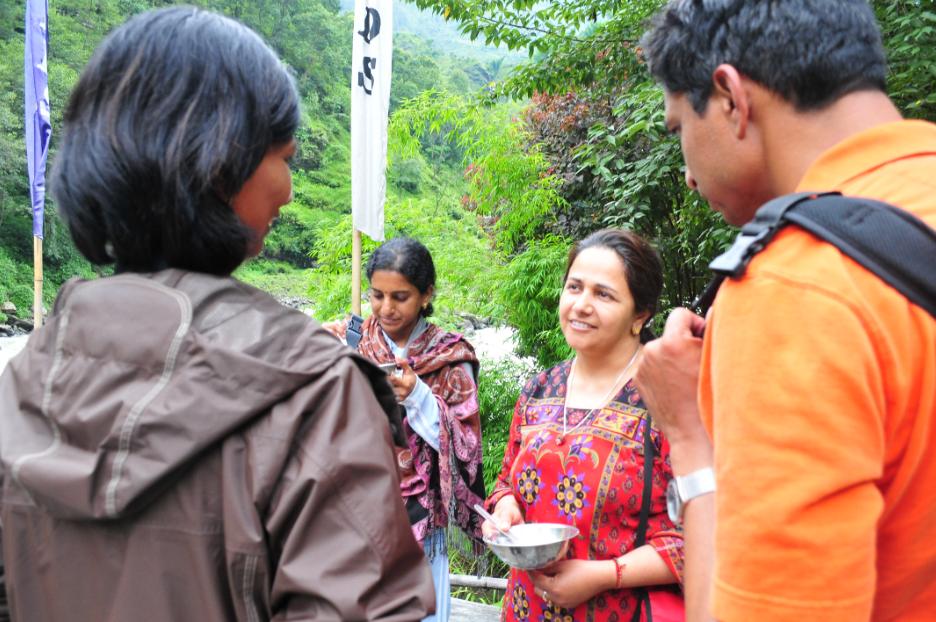
| Anu, Shailaja, Alka, Sairam - saw Alka smiling after a long time |
 |
| Can never thank them enough... |

 |
| Seema at the river bank, Borderland resort |

As usual, Seema had found a way for us to go touch the water, and just about the time that we reached the river, we heard the ear-shattering whistles from Rajeev and Yogananda, and like trained dogs, we obediently turn to leave. Rajeev and Yoga have been given these whistles since we entered Tibet to herd up the people, I think they have enjoyed the whistling way too much.
 |
| My sweetest and youngest fellow traveler, Varsha Appaji |

The driver appeared to like driving, and despite the delays we had encountered already, he took a long circuitous route once we entered Kathmandu. What was expected to be a five-hour journey took eight hours and there were cheers when the bus finally reached the hotel gates. I am quite sure the sarcasm was lost on the driver. The extra time was well used in my bus for some chanting - the energetic rendering of the Mahishasura Mardini stotram that I love to hear and only know one line of :), and some others that I faintly recognize or not at all - I grew up in the same country learning only the Catholic prayers said at school. To this day, the only complete prayer I know is the Lord's Prayer that I say at any temple, shrine or deity. Now, having gone through the challenge of trying to memorize Sanskrit stotrams as an adult, I recommend the memorization of Sanskrit with accuracy in recitation from childhood. I am amazed by my friends from Andhra who recite gazillion lines in Sanskrit without having to look at a book. I have been given a second chance in life for learning, not everyone gets that opportunity.
The eight-hour journey cramped in a bus seat had turned my legs into balloon art - I did not have ankles anymore, my legs were swollen into tubes. My Manas Sarovar jal was lost - I had forgotten the containers in my room at Chiu Gompa, it was handed to Swarn and that was the last anyone ever saw them. Repeated reminders in the last three days had borne no result, I had been told the cars would be searched, the Sherpas would be asked, the truck would be searched, nothing had happened yet. The cars were already gone when we crossed the border in Tibet, the truck would leave if not checked quickly at Kathmandu, and tomorrow morning we would be in Delhi. Instead of an apology for losing my things, I was being told that I can go buy a can from the market and Shrestha can give me some of the additional Manas Sarovar jal. This is the last straw. I hate to do this at the end of a satisfying journey, but I had to articulate that I was a paying customer, and I would like Shrestha to make things happen, the jal needed to be delivered to me in a way that I can carry it to Delhi.
When we arrived at the hotel, chaos reigned again, no surprise!!! Some duffel bags were lying on the grass. We were told they would be delivered to the rooms. At the rooms, we found more duffel bags strewn in the grass and it has now started drizzling. My bag was not outside the room, it must still be lying in the grass outside the hotel reception. When I walked back there, there are four people from Shrestha to stand and stare. The hotel manager was talking incessantly into his mobile without any progress on the bag situation. A couple of hotel employees were now bringing the wet bags from the grass to a covered area. I saw my bag now, and asked the manager to have it delivered to my room and give him the number, and finally walked back in the rain on my swollen feet to shower and change for the final meeting at 8pm. At the room again, and no bag. I walked back to the reception counter, now my bag was not there either though it had not been delivered to my room. When I asked the manager where the bags had gone, he told me they were delivered which I assured him mine was not. He told me to go check again. Time again for my second speech today on "let me remind you who the paying customer is" but the hotel manager was too busy on his mobile. When he got free from his many conversations, I told him my luggage tags (for my international bags stored in the hotel) were in my duffel bag which I have not received yet, so how do I get my bags back because it was time to start packing for Delhi now. The answer is not "we will need a photo ID" or "please come back at 8 so we can take you to identify your bags" etc. It is "you will have to wait". All rightey then, time to throw a hissing fit about the hotel's service standards and the lack of basic common sense as well as the apathy of the Shrestha onlookers while customers run from pillar to post searching for their bags, most of which are now wet in the rain. The emotional feedback got due attention that soft-spoken queries were not getting, and I was off in a car with a hotel employee towards the rooms to search for my duffel bag.
The question arises why do service providers wait for the customer to be irate before providing basic services??? Why does the decibel level need to be high for us to act??? CRM 101 needs to be a mandatory course in all schools and colleges globally so that we get service of a consistent quality anywhere we go. If the manager had apologized that I had to walk between buildings twice just to ask about my bags, and that he would make sure my bag reached my room, I would have walked back to my room for the third time without kicking up a fuss. We found the bags in a common area, completely wet - it was dumped in the heap of unclaimed wet bags outside the guest building even though it was raining and the dumper should have known better and the dumper was the hotel employee to whom the room number was given very clearly. I explained to the hotel people that if my clothes inside were wet, they would be ironing them all night so I can leave for Delhi in the morning. Of course, my belongings are dry as the desert air, I had packed everything in sealed ziploc bags. I now walked back on my swollen feet one last time to give my luggage tags to the hotel reception to get my international bags.
Rajeev did a great job as the MC for the 8 pm meeting to express our thanks to the gurus, inviting some people to share their experiences. Throughout our trip, at each new place, as we dragged our aching bodies and our bags from our cars, Rajeev would have figured out room allotment and would be announcing it cheerfully. Not sure we thanked him enough. With Bose, Srihari, Yogananda, Rajeev and others, I think the Swamijis chose the perfect volunteers from the group to do the most tedious tasks in a spirit of service. A lady who described Swami Shivayogananda's advice to her before trekking around Kailash gave a very modest and humble and honest close-to-the-heart speech that spoke to me.
I could not believe this was over, I did not think I got enough time with the Masters, I did not think I learned as much as I should have, I did not feel I had experienced enough to change much, I could only hope the spiritual experience of this trip stays with me and reveals itself over the years. No amount of guru dakshina - offering to the guru, can correctly represent my gratitude for what the Swamijis have done for the group - leading us to Kailash and Manas Sarovar, chanting stotrams that I am now inspired to learn, the satsang - discourses that I can never get enough of, and even the bhajans - hymns that, ahem... help me relax. And they have gone beyond the role of acharya - spiritual leaders, and taken on the organization and detailed planning for this trek and they have been directly accessible as the main contact persons for any issue or question.
Swarn handed out certificates for the Kailash - Manas Sarovar trek for the group. AND, delivered Manas Sarovar jal for me, I had something to take back now. Many people had by now offered to share their jal with me if I did not get anything. One more reason to go with a harmonious group like the Chinmaya Mission group for such treks.
And dinner had sugarless yogurt alongside the pre-sweetened yogurt. Finally!!!!
It took two hours to pack everything into my international bags and they are well over the 20kg limit of Jet Airways.
Ab Dilli Door Nahin - Delhi is not far now.
Aum Namah Shivaaya!!
Saturday, June 26, 2010
Kailash 2010 Day 3: Kathmandu to Nyalam, Sunday Jun 27, 2010
The plan is to go by bus from Kathmandu to the border at Kodari, about 123 kms. We will have lunch on the way before Kodari. After the immigration formalities, we would enter Tibet, where cars would be waiting for us. These Toyota Landcruisers will take us around in Tibet. Today, we would drive about 30 km to Nyalam, 3750m (12,300 ft).
We started the day with the morning pooja. I remembered to give Amma the prasad - offerings, from Pashupatinath. Her helpers cut the coconut so that slices could be distributed to everyone in the buses.
We started off from Kathmandu looking out at one of the most scenic countrysides in the world. Each view from the bus window is one in a sequence of picture post cards. A group of people in the bus started chanting - the energy of the vigorous chant was infectious.
An hour outside of Kathmandu is an amazing tall statue of Shiva, on a mountain top that has a commanding view of the valley as the buses make their way through the roads spiralling upwards towards the Chinese border.
Yoga pointed out a hydro power station on the Bhotekosi river - should it be so close to the Chinese border?
And finally, the 180 m tall bungy jump site I have researched so much, about 12 km away from the Tibet border. When I jumped in Taupo in New Zealand, it was over the Waikato river - very peaceful and scenic site, and I had looked around one last time before I jumped in case my head hit the water or I went blind - rare but possible. Nothing of the sort happened, it was a fantastic sensory experience of free fall and then bouncing up and down over the river, my ankle tied to the elastic rope. But six years ago, at Lakshman Jhoola in Hrishikesh, I could not walk even 50 steps on the suspension bridge as it shook over the raging river Ganga. I have wanted to jump off one of these suspension bridges towards a raging river since then. I hope we can stop here on the way back for a jump from Nepal's longest steel rope suspension bridge over the raging Bhote Kosi river. I wanted to put all my fears of heights, deep water and shaking structures into this one jump in Nepal, hopefully on the way back from Tibet.
Six months ago, after offering the beverage of choice at the highest seat of tantra, the temple of Kal Bhairav, the fierce form of Shiva used for annihilation, I was delighted to know that the dog is associated with him. Taking care of dogs is a form of worship of Kal Bhairav. Not that I need one more visual icon to remind me of Shiva.
Once we reached the border town of Kodari, there was a 1 km uphill road to the Friendship Bridge that we needed to cross on foot into Tibet. Mallik is my perfect bade bhaiya - big brother, walking every step with me along the way and within 20 steps convincing me to hire a baby porter for my camera equipment. The 15-yr-old porter put me to shame, walking eagerly with me carrying my camera equipment, and talking enthusiastically about how he could also cross the border and help me till my car in Tibet. Once at the Friendship Bridge, there was an imposing Chinese building from which people watched over us. Nobody from Nepal appeared to be watching, which is why the Chinese side was so intimidating. A lot of chaos about who stands in what line, sorted again thanks to the Chinmaya discipline with the appointed volunteers and personal instructions from Swamiji, and finally I was in line for my entry into Tibet. I paid 50 INR to my ecstatic baby porter who appeared to be bragging to other baby porters. After the passport check in the middle of the bridge by the Chinese authorities, I carried my bags into Tibet and stood in the slow-moving lines at the immigration counters. It was now an hour since I had got off the bus.
Another hour later, finally somebody in Immigration was looking at my passport and he called his supervisor. They talked quite a bit in Chinese and started laughing, and looked at me and laughed again. I was hoping they were not laughing at some missing stamp on my passport - ha ha, she needs to go back to Nepal to get that. Then the supervisor asked me in English where I lived, - Dallas, I said. And where was I coming from? - India and then Nepal, I said. With his fingers, he pulled his eyes into further slits, and said - we think you are Tibetan. They were both hysterical now. I get the joke - I appear to be a Tibetan who lives in Dallas and is coming to China through Nepal on an Indian passport. I was fervently hoping this was not a prelude to an interrogation. It was not, they probably realized by then that they had made me quite nervous, they were very warm and cordial and made some small talk to put me at ease, and wished me a good trip. To them it did not matter that I called myself Indian, I looked like one of their own. Swamiji told me later that he has not seen the Chinese officers get so friendly with anyone. It is strange how affectionate people get with perceived apnewaale - own people.
We waited another hour and a half till all passports were processed. And then off to the cars waiting for us. Swarn from Shrestha had warned us very helpfully that the cars may not be parked close by and we need to be prepared to walk another kilometer. Luckily for us, they were parked close by, and again, Jay Ho to the Chinmaya discipline - in no time, we had four passengers alloted to each car, and we were given car numbers to search for.
The car drivers were Tibetan, ours could not speak English or Hindi - we would have to communicate with sign language, this was going to be an interesting trip. The driver knew the Sanatana Dharma chants though - and started with a vigorous Aum Namah Shivaaya - obeisance to Shiva, Kailashpati ki Jay - glory to the lord of Kailash, etc etc. Then he started his own prayers, and for 15-20 minutes chanted under his breath.
After a hair-raising drive for maybe half an hour through dust paths and cement blocks on a road that is still being built, we stopped at ZhangMu, we did not know why. It was stuffy inside the car, and as we sat on the ground under the awning of a store, the local residents looked at us curiously from balconies. Some of them came up much closer to check us out - reminded me of my Pooh bear co-traveler in the flight from Chicago. I am now getting used to being stared at.
An hour later, our driver appeared and we set off for Nyalam, an hour away. Later, we found out from Swarn that there is a check post in ZhangMu, and the drivers had to collectively get a permit. The vast landscape, the winding roads, the waterfalls, the step farms, the sheer drop on one side and the risk of landslides reminded me somewhat of the road to Badrinath, which is decidedly much riskier. At a couple of places, the road had a roof on which fell a mountain stream, and at another place, the mountain stream passed under the road - either way, the car is not splashed and the road is not wet - some engineer with an aesthetic sense is building these structures.
In Nyalam, at the Shesha Bangma hotel that is really a guesthouse with basic facilities, we were four or five or six or even seven to a room with little space between the beds to keep our duffel bags. Again planned order brought in by Chinmaya volunteers. It took one quick announcement from Rajeev to scuttle people into rooms. This was the first time I got to meet people from India - Seema from Delhi and Niveditha from near Bangalore. I would be sharing my bed with my two backpacks and my heavy jacket.
The Swamijis announced that they would be serving dinner. There is nothing more awkward than being served by men on the path of renunciation whom we should be serving hand and foot. This lasted all of two meals with protests from many people in the group. After that, we had volunteers to serve the food when the Sherpas brought it in. The food ran out for the first couple of meals - either the Sherpas did not cook enough, or we served too much, or we ate too much, or we got served too much and wasted it. Additional meals had to be cooked for the volunteers for two meals in a row, after which the calculations appear to get corrected. There was an assigned volunteer for each Swamiji to make sure they were served before we were.
Again this evening, more bhajans - hymns, rather than my preferred satsang - discourse, but it was a group and whatever worked for the larger number was what I needed to go with.
Tomorrow, an acclimatization trek, I hope I can make it.
Aum Namah Shivaaya!!
We started the day with the morning pooja. I remembered to give Amma the prasad - offerings, from Pashupatinath. Her helpers cut the coconut so that slices could be distributed to everyone in the buses.
 |
| Br Vinayak Chaitanya, Br Uddhav Chaitanya, Br Suved Chaitanya, Swami Shivayogananda, Br Jaganmitra, Br Anshuman Chaitanya - the magic of yellow and ochre |
 |
| Our backpacks and duffel bags are the sea in red |
 |
| Getting ready to leave Kathmandu |
 |
| Srini and Usha Amble, the Diamox man and his woman |
 |
| Enjoying God's view of the world, driving from Kathmandu to Kodari |
 |
| View of the valley, on way from Kathmandu to Kodari |
 |
| Statue of the hermit Shiva, on top of a mountain, on way from Kathmandu to Kodari |

 |
| Amma and others at a chai ki dukan - tea stall, Nepal countryside |

 |
| Step farms for paddy in the Nepal countryside |

And finally, the 180 m tall bungy jump site I have researched so much, about 12 km away from the Tibet border. When I jumped in Taupo in New Zealand, it was over the Waikato river - very peaceful and scenic site, and I had looked around one last time before I jumped in case my head hit the water or I went blind - rare but possible. Nothing of the sort happened, it was a fantastic sensory experience of free fall and then bouncing up and down over the river, my ankle tied to the elastic rope. But six years ago, at Lakshman Jhoola in Hrishikesh, I could not walk even 50 steps on the suspension bridge as it shook over the raging river Ganga. I have wanted to jump off one of these suspension bridges towards a raging river since then. I hope we can stop here on the way back for a jump from Nepal's longest steel rope suspension bridge over the raging Bhote Kosi river. I wanted to put all my fears of heights, deep water and shaking structures into this one jump in Nepal, hopefully on the way back from Tibet.
 |
| Bungy jump site over the Bhotekosi |
 |
| Our truck is about to get stuck |
After a 3-hour drive, a couple of short breaks, and a lunch break preceded by an exciting stuck-in-the-mud situation where the Sherpas, other bus drivers and the locals all helped push and pull to get us unstuck, we reached the Kodari border.
Six months ago, after offering the beverage of choice at the highest seat of tantra, the temple of Kal Bhairav, the fierce form of Shiva used for annihilation, I was delighted to know that the dog is associated with him. Taking care of dogs is a form of worship of Kal Bhairav. Not that I need one more visual icon to remind me of Shiva.
 |
| A man and his best friend |
Once we reached the border town of Kodari, there was a 1 km uphill road to the Friendship Bridge that we needed to cross on foot into Tibet. Mallik is my perfect bade bhaiya - big brother, walking every step with me along the way and within 20 steps convincing me to hire a baby porter for my camera equipment. The 15-yr-old porter put me to shame, walking eagerly with me carrying my camera equipment, and talking enthusiastically about how he could also cross the border and help me till my car in Tibet. Once at the Friendship Bridge, there was an imposing Chinese building from which people watched over us. Nobody from Nepal appeared to be watching, which is why the Chinese side was so intimidating. A lot of chaos about who stands in what line, sorted again thanks to the Chinmaya discipline with the appointed volunteers and personal instructions from Swamiji, and finally I was in line for my entry into Tibet. I paid 50 INR to my ecstatic baby porter who appeared to be bragging to other baby porters. After the passport check in the middle of the bridge by the Chinese authorities, I carried my bags into Tibet and stood in the slow-moving lines at the immigration counters. It was now an hour since I had got off the bus.
Another hour later, finally somebody in Immigration was looking at my passport and he called his supervisor. They talked quite a bit in Chinese and started laughing, and looked at me and laughed again. I was hoping they were not laughing at some missing stamp on my passport - ha ha, she needs to go back to Nepal to get that. Then the supervisor asked me in English where I lived, - Dallas, I said. And where was I coming from? - India and then Nepal, I said. With his fingers, he pulled his eyes into further slits, and said - we think you are Tibetan. They were both hysterical now. I get the joke - I appear to be a Tibetan who lives in Dallas and is coming to China through Nepal on an Indian passport. I was fervently hoping this was not a prelude to an interrogation. It was not, they probably realized by then that they had made me quite nervous, they were very warm and cordial and made some small talk to put me at ease, and wished me a good trip. To them it did not matter that I called myself Indian, I looked like one of their own. Swamiji told me later that he has not seen the Chinese officers get so friendly with anyone. It is strange how affectionate people get with perceived apnewaale - own people.
 |
| Yoga near the cars in Tibet |

We waited another hour and a half till all passports were processed. And then off to the cars waiting for us. Swarn from Shrestha had warned us very helpfully that the cars may not be parked close by and we need to be prepared to walk another kilometer. Luckily for us, they were parked close by, and again, Jay Ho to the Chinmaya discipline - in no time, we had four passengers alloted to each car, and we were given car numbers to search for.
The car drivers were Tibetan, ours could not speak English or Hindi - we would have to communicate with sign language, this was going to be an interesting trip. The driver knew the Sanatana Dharma chants though - and started with a vigorous Aum Namah Shivaaya - obeisance to Shiva, Kailashpati ki Jay - glory to the lord of Kailash, etc etc. Then he started his own prayers, and for 15-20 minutes chanted under his breath.
After a hair-raising drive for maybe half an hour through dust paths and cement blocks on a road that is still being built, we stopped at ZhangMu, we did not know why. It was stuffy inside the car, and as we sat on the ground under the awning of a store, the local residents looked at us curiously from balconies. Some of them came up much closer to check us out - reminded me of my Pooh bear co-traveler in the flight from Chicago. I am now getting used to being stared at.
 |
| Curious onlooker at Zhang-mu |
 |
| Curious passer-by at Zhang-mu |
 |
| Mountain stream, on way to Nyalam |

 |
| And finally, Shesha Bangma hotel in Nyalam |
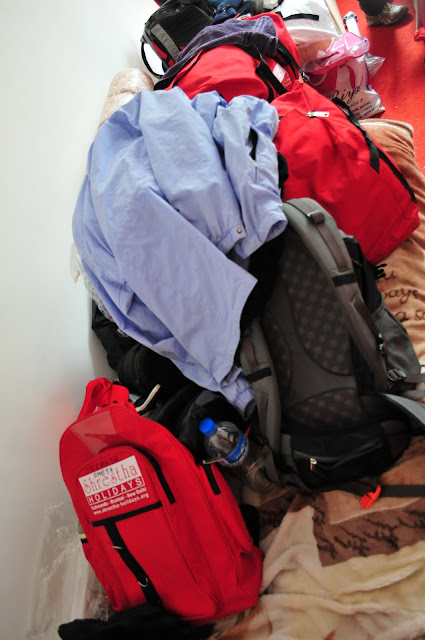 |
| I share my bed with my stuff |
 |
| Being served food by Swamijis, awkward |

Tomorrow, an acclimatization trek, I hope I can make it.
Aum Namah Shivaaya!!
Kailash 2010 Day 2: Acclimatization at Kathmandu, Saturday Jun 26, 2010
Mallik and I did not go to the Shiva temple of Pashupatinath at 4 am, as we had hoped to do for many weeks in Dallas.
This was the day of the first morning pooja - worship ceremony, at 7. Wore salwar-kameez and did not know it then, but the next time that I was to wear salwar-kameez again would be on the last day of the trip, back at Kathmandu, fourteen days later. Which basically means, I had a few sets of salwar-kameez in my duffel bag that were never used. :) My recommendation to travelers - you only need mountain gear in Tibet.
The group trip to the temple of Pashupatinath started at 9 in the morning, after a heavy breakfast. Private citizens are allowed to perform rituals in the sanctum sanctorum of the 12 main temples of Shiva in India, the Jyotirlingas. At the temple of Pashupatinath in Kathmandu - the only Shiva temple in the world equivalent to, or even higher than the Jyotirlingas, only the temple priests are currently allowed to set foot in the sanctum sanctorum. I would not get to perform the rudrabhishek - the worship ritual that I have been performing at the Jyotirlingas. So be it. But after standing in line for half an hour, when I finally got a glimpse of the deity, the priest asked me - pooja karni hai? - do you want to perform the worship ritual? The face of that priest is etched in my mind - I sometimes get this feeling that Shiva has come to me as people who have helped me along the way, probably my reaction to Jim Carrey's character in Bruce Almighty never recognizing God.
The priest had to ask me twice because I was not sure this was happening. After I nodded yes, he collected all the pooja material from within the temple - the coconut, milk, yogurt, honey, sugar, ghee, fruit, nuts, bilwa leaves, flowers, garland, rudraaksh necklace, water, lamp, plate, and the list goes on. For each step of the pooja, he would ask me to touch things that he would then take to the deity and perform the rituals, and finally, he asked me to perform the aarti - the final ritual to end the worship ceremony. I know there were security guards and other temple volunteers very loud and actively keeping the line moving. I am not sure what happened during the time that I stood at one spot, performing the pooja - it should have been a good 20 minutes or more. I was too engrossed and heard nothing till the priest gave me the rudraaksh necklace and also the coconut, sugar cubes and fruit, that had been offered to the deity. It was exactly six months to the day Anish, Ash and I had performed the rudrabhishek at the Mahakaleshwar temple in Bhopal after the bhasma-arti - the worship ritual with ashes. Perfect start to a perfect day and a good sign for a perfect trip!!
It was June 26, a full-moon day, and also the day of the first lunar eclipse of 2010 - a partial eclipse was to be viewed from some parts of the world. For those who know far more than I do about the import of the lunar calendar, today was Jyeshtha Poornima - the full moon day in the Hindu month of Jyeshtha. From the little I know, Ashad, the fourth month of the Hindu calendar would now begin, per the north Indian Hindu calendar - an auspicious month for worship ceremonies and pilgrimages. Per the calendar from south India that the Swamijis follow, the second-half of the month of Jyeshtha had started, the fortnight of the waning moon. A fortnight later, we would have completed our trip and I would be in Ahmedabad in time for the rath yatra - the chariot ride, for the divine Krishna and siblings, that takes place two days after the new moon in the month of Ashad.
The statue of Nandi, the bull, outside the temple of Pashupatinath is gigantic. The face of Nandi has a look of longing and ecstasy as it looks at the temple - Mallik and I both noticed that emotion on the bull's face, my regards to the unnamed sculptors who built this for the millions of piligrims to visit through the centuries. No pictures, my camera equipment was in the hotel, and I now recall everything from memory.
In the temple campus, they had opened up a hitherto-closed section where there are 108 Shivalingas. Behind the temple are the ghats, - the banks of the river Baghmati. As I looked down from the temple and saw the water, I did not understand what I was looking at, till Kalpakkam-ji pointed out a cremation in progress. And then I saw two more bodies waiting in line. This is the first temple I have seen where funerals can be seen from the temple premises.
Adi Shankara re-established Sanatana Dharma, called Hinduism by the Persians and later by the rest of the world, more than two milleniums ago as the mainstream faith practice in India when the population was getting divided into sects and sub-sects, and getting lost in rituals without the knowledge-seeking activity that is essential to sustaining Dharma. I see his lifetime of 32 years as a bright light in the midst of the blackness and mist of the centuries. He renounced worldly life at the age of 8, learned from gurus, and spread the word of Dharma. He established Advaita as the dominant school of philosophy in Sanatana Dharma. Advaita is the philosophy of non-duality (of the nature of Brahman, the supreme consciousness). He traveled the length and breadth of Aryavrata, what is currently the Indian sub-continent and re-vitalized countless temples and re-established Vedic practices.
In remote temples, I have always been humbled by the presence of Adi Shankara's padchihna, - footprints. These ancient temples for which I book flights, cars, drivers, porters and ponies, were visited by Adi Shankara on foot at a tender age many centuries ago - in Badrinath where Adi Shankara dove to the exact spot in the river to retrieve the idol of Vishnu as he had seen in his dream, in Joshimath where he meditated in a cave for several years, in Kashmir where he re-established the worship at the Shiva temple outside Srinagar, Kedarnath at 12K ft in the lower Himalayas where I have so far felt closest to Shiva and where Shankara re-established worship and ultimately passed away there. And now I was hoping to see Kailash where I would hopefully experience Dakshinamoorthy as described by Adi Shankara - the glory of the formless Shiva imparting knowledge in silence as the students sit in quiet contemplation. The highly complex philosophy of Advaita cannot be taught, it has to be experienced - repeated chanting of the Dakshinamoorthy stotram is an aid to this experience for the students of Advaita.
In the temple complex of Pashupatinath, there is an Adi Shankara temple as well, and oddly, there was a cow standing on the temple steps. I tickled the cow quite a bit, I missed Snowy so much. Snowy's role in our Dallas household is to increase awareness and affection for the animal kingdom. We believe she was a cow in her previous life who has taken this birth just so she can wag her tail and lick people. From Adi Shankara to Snowy in 2 seconds, such is the attention span of people like me that the Swamijis have to deal with.
 At a store near the temple, people went crazy buying perfect-looking rudraaksh - prayer beads. It is the seed of an evergreen tree that grows in the Himalayan region in India and Nepal. There are many varieties, I have no ability to recognize genuine rudraaksh, and these beads looked too perfect to be natural products. My concern was not that I would waste money, it was that I already had lots of wannabe-rudraksh at home.
Last year, at the Sandeepani ashram in Bhopal, as I was leaving the Shiva temple, a man sitting in the sanctum sanctorum had offered me a single rudraaksh bead which he explained was exceptional - I forget the reasons, I am quite sure he was cashing in on my naivete. I looked around for Anish to pay up, but he had already left the temple. I looked into my purse and all I had was 1000-INR notes. Surely, the man expected much less. After a moment's hesitation, I gave him 1000 INR. It did not feel right to ask for change back while standing inside a Shiva temple and receiving rudraaksh. And as of today, I had the rudraksh garland from the priest at Pashupatinath. I did end up buying 3 basic rudraaksh garlands - after Srihari suggested I could buy garlands and dip them in the Manas Sarovar waters - one for us at Dallas, one for my parents and one for my parents-in-law.
Our next stop was a Buddhist stupa. The intolerable June heat of Kathmandu did not allow us to enjoy much. It was a hurry-scurry around the stupa, talk a bit and rush to the bus that had fans that did not work. Hopefully, if the bus moved quickly enough, there would be a breeze.
The last stop was the temple of Jal Narayana or sleeping Vishnu, better known as the Budhanilkantha temple. It has a striking statue of Vishnu, the benefactor aspect of the Divine, lying on a bed of snakes in cosmic waters. Legend has it that the royal family of Nepal is cursed not to see this idol of Vishnu, else it will destroy the family. And local rumor has it that the massacre of the Nepali royal family in 2001 by the crown prince Dipendra was caused by his visit to this temple in his college days.
After lunch at the hotel, Mallik and I made a trip to the temple of Bhadrakali, the destroyer-of-evil form of the Divine Mother. There is a definite Asian influence in the building, as seen by the sculpture of the lions that surround this little temple. The maintenance of the temple appears to be done by a family who lives close by, there were children scrubbing and cleaning the whole time that we were there. Right after Mallik and I had completed our worship and came out of the temple, there was a quick and heavy downpour for about two to three minutes and just as people ran for cover, it stopped as suddenly as it had started. Both of us had the same thought - that somebody had showered blessings on us. It is the best day of my life, a visit to the most holy Shiva temple in the world and a visit to an ancient Bhadrakali temple on the same day - Jun 26, 2010.
We went shopping in Kathmandu's shopping area, Thamil, to buy T-shirts to give as gifts to the Sherpas and the porters. Another recommendation: we found T-shirts for INR 150-200 in Nepal, but if I had known this earlier, I would have bought better ones from home, and would have saved an hour that I spent searching for T-shirts in Kathmandu. I had wanted to visit the palace of the virgin goddess that I did not have time to go to.
We had our first satsang - discourse, this evening, quite short with most of the time taken up by bhajan - hymn singing by assorted people. In my humble opinion, singing hymns helps the mind focus on a deity. It is not my experience that it uplifts me spiritually. Listening to songs and music does rest me physically by sometimes putting me to sleep as Anish discovered after I slept through a classical music concert for which he had purchased premier seating. He goes alone to music events since then, and I respect that. :) A lady singing in Tamil was an amazing singer, she sounded like a recording - even my tone deaf ears could figure that, I understood not a thing except that she was a devout worshiper. Actual intellectual debate would clarify my understanding of subjects. With six swamijis, I was hoping I get to hear a couple of days' words of wisdom from each.
And after a super-heavy dinner with the sweet yogurt, finally it was 10pm. We had to turn in all bags including my veteran international bags. My roomie Kalpakkam-ji - worrying and careful - is the perfect complement to my I-can-handle-anything-and-manage-everything attitude. She lives in Phoenix, and she had joined the Dallas group for this trip. We had to furiously pack everything into the duffel bags we have been given. I am glad I did not bring the $$$ duffel bag and the $$$ back pack we had bought earlier, I would have looked like a Saks commercial in this sea of basic bright red pizza-box-carrier duffel bags and bright red I-love-kindergarten backpacks.
I sent my last e-mail to Anish and Ash, my parents and my in-laws, saying I will be leaving Kathmandu the next morning, and will catch up with them when I get back. Swamiji had told me that one's life had to be sinless to find a final resting place in Kailash, the conclusion being - no worries about my dying there. I fully agree with the evaluation but I have hope. One day my ashes will be sprinkled on the Himalayas, why not take the body when I am bringing it there?
Aum Namah Shivaaya!!
This was the day of the first morning pooja - worship ceremony, at 7. Wore salwar-kameez and did not know it then, but the next time that I was to wear salwar-kameez again would be on the last day of the trip, back at Kathmandu, fourteen days later. Which basically means, I had a few sets of salwar-kameez in my duffel bag that were never used. :) My recommendation to travelers - you only need mountain gear in Tibet.
 |
| Morning pooja in Kathmandu (Sairam's collection) |
 |
| Amma, waiting to leave for the temple |

The priest had to ask me twice because I was not sure this was happening. After I nodded yes, he collected all the pooja material from within the temple - the coconut, milk, yogurt, honey, sugar, ghee, fruit, nuts, bilwa leaves, flowers, garland, rudraaksh necklace, water, lamp, plate, and the list goes on. For each step of the pooja, he would ask me to touch things that he would then take to the deity and perform the rituals, and finally, he asked me to perform the aarti - the final ritual to end the worship ceremony. I know there were security guards and other temple volunteers very loud and actively keeping the line moving. I am not sure what happened during the time that I stood at one spot, performing the pooja - it should have been a good 20 minutes or more. I was too engrossed and heard nothing till the priest gave me the rudraaksh necklace and also the coconut, sugar cubes and fruit, that had been offered to the deity. It was exactly six months to the day Anish, Ash and I had performed the rudrabhishek at the Mahakaleshwar temple in Bhopal after the bhasma-arti - the worship ritual with ashes. Perfect start to a perfect day and a good sign for a perfect trip!!
It was June 26, a full-moon day, and also the day of the first lunar eclipse of 2010 - a partial eclipse was to be viewed from some parts of the world. For those who know far more than I do about the import of the lunar calendar, today was Jyeshtha Poornima - the full moon day in the Hindu month of Jyeshtha. From the little I know, Ashad, the fourth month of the Hindu calendar would now begin, per the north Indian Hindu calendar - an auspicious month for worship ceremonies and pilgrimages. Per the calendar from south India that the Swamijis follow, the second-half of the month of Jyeshtha had started, the fortnight of the waning moon. A fortnight later, we would have completed our trip and I would be in Ahmedabad in time for the rath yatra - the chariot ride, for the divine Krishna and siblings, that takes place two days after the new moon in the month of Ashad.
The statue of Nandi, the bull, outside the temple of Pashupatinath is gigantic. The face of Nandi has a look of longing and ecstasy as it looks at the temple - Mallik and I both noticed that emotion on the bull's face, my regards to the unnamed sculptors who built this for the millions of piligrims to visit through the centuries. No pictures, my camera equipment was in the hotel, and I now recall everything from memory.
In the temple campus, they had opened up a hitherto-closed section where there are 108 Shivalingas. Behind the temple are the ghats, - the banks of the river Baghmati. As I looked down from the temple and saw the water, I did not understand what I was looking at, till Kalpakkam-ji pointed out a cremation in progress. And then I saw two more bodies waiting in line. This is the first temple I have seen where funerals can be seen from the temple premises.
Adi Shankara re-established Sanatana Dharma, called Hinduism by the Persians and later by the rest of the world, more than two milleniums ago as the mainstream faith practice in India when the population was getting divided into sects and sub-sects, and getting lost in rituals without the knowledge-seeking activity that is essential to sustaining Dharma. I see his lifetime of 32 years as a bright light in the midst of the blackness and mist of the centuries. He renounced worldly life at the age of 8, learned from gurus, and spread the word of Dharma. He established Advaita as the dominant school of philosophy in Sanatana Dharma. Advaita is the philosophy of non-duality (of the nature of Brahman, the supreme consciousness). He traveled the length and breadth of Aryavrata, what is currently the Indian sub-continent and re-vitalized countless temples and re-established Vedic practices.
In remote temples, I have always been humbled by the presence of Adi Shankara's padchihna, - footprints. These ancient temples for which I book flights, cars, drivers, porters and ponies, were visited by Adi Shankara on foot at a tender age many centuries ago - in Badrinath where Adi Shankara dove to the exact spot in the river to retrieve the idol of Vishnu as he had seen in his dream, in Joshimath where he meditated in a cave for several years, in Kashmir where he re-established the worship at the Shiva temple outside Srinagar, Kedarnath at 12K ft in the lower Himalayas where I have so far felt closest to Shiva and where Shankara re-established worship and ultimately passed away there. And now I was hoping to see Kailash where I would hopefully experience Dakshinamoorthy as described by Adi Shankara - the glory of the formless Shiva imparting knowledge in silence as the students sit in quiet contemplation. The highly complex philosophy of Advaita cannot be taught, it has to be experienced - repeated chanting of the Dakshinamoorthy stotram is an aid to this experience for the students of Advaita.
In the temple complex of Pashupatinath, there is an Adi Shankara temple as well, and oddly, there was a cow standing on the temple steps. I tickled the cow quite a bit, I missed Snowy so much. Snowy's role in our Dallas household is to increase awareness and affection for the animal kingdom. We believe she was a cow in her previous life who has taken this birth just so she can wag her tail and lick people. From Adi Shankara to Snowy in 2 seconds, such is the attention span of people like me that the Swamijis have to deal with.
 |
| Rudraksh and other purchases at the store outside Pashupatinath temple |
At a store near the temple, people went crazy buying perfect-looking rudraaksh - prayer beads. It is the seed of an evergreen tree that grows in the Himalayan region in India and Nepal. There are many varieties, I have no ability to recognize genuine rudraaksh, and these beads looked too perfect to be natural products. My concern was not that I would waste money, it was that I already had lots of wannabe-rudraksh at home.Last year, at the Sandeepani ashram in Bhopal, as I was leaving the Shiva temple, a man sitting in the sanctum sanctorum had offered me a single rudraaksh bead which he explained was exceptional - I forget the reasons, I am quite sure he was cashing in on my naivete. I looked around for Anish to pay up, but he had already left the temple. I looked into my purse and all I had was 1000-INR notes. Surely, the man expected much less. After a moment's hesitation, I gave him 1000 INR. It did not feel right to ask for change back while standing inside a Shiva temple and receiving rudraaksh. And as of today, I had the rudraksh garland from the priest at Pashupatinath. I did end up buying 3 basic rudraaksh garlands - after Srihari suggested I could buy garlands and dip them in the Manas Sarovar waters - one for us at Dallas, one for my parents and one for my parents-in-law.
 |
| Stupa in Kathmandu (Sairam's collection) |
 |
| Vishnu lying on a bed of snakes in cosmic waters, Budhanilkantha temple (Yoga's collection) |
After lunch at the hotel, Mallik and I made a trip to the temple of Bhadrakali, the destroyer-of-evil form of the Divine Mother. There is a definite Asian influence in the building, as seen by the sculpture of the lions that surround this little temple. The maintenance of the temple appears to be done by a family who lives close by, there were children scrubbing and cleaning the whole time that we were there. Right after Mallik and I had completed our worship and came out of the temple, there was a quick and heavy downpour for about two to three minutes and just as people ran for cover, it stopped as suddenly as it had started. Both of us had the same thought - that somebody had showered blessings on us. It is the best day of my life, a visit to the most holy Shiva temple in the world and a visit to an ancient Bhadrakali temple on the same day - Jun 26, 2010.
 |
| Bhadrakali temple, Kathmandu |
We went shopping in Kathmandu's shopping area, Thamil, to buy T-shirts to give as gifts to the Sherpas and the porters. Another recommendation: we found T-shirts for INR 150-200 in Nepal, but if I had known this earlier, I would have bought better ones from home, and would have saved an hour that I spent searching for T-shirts in Kathmandu. I had wanted to visit the palace of the virgin goddess that I did not have time to go to.
 |
| Marketplace, Thamil, Kathmandu |
And after a super-heavy dinner with the sweet yogurt, finally it was 10pm. We had to turn in all bags including my veteran international bags. My roomie Kalpakkam-ji - worrying and careful - is the perfect complement to my I-can-handle-anything-and-manage-everything attitude. She lives in Phoenix, and she had joined the Dallas group for this trip. We had to furiously pack everything into the duffel bags we have been given. I am glad I did not bring the $$$ duffel bag and the $$$ back pack we had bought earlier, I would have looked like a Saks commercial in this sea of basic bright red pizza-box-carrier duffel bags and bright red I-love-kindergarten backpacks.
I sent my last e-mail to Anish and Ash, my parents and my in-laws, saying I will be leaving Kathmandu the next morning, and will catch up with them when I get back. Swamiji had told me that one's life had to be sinless to find a final resting place in Kailash, the conclusion being - no worries about my dying there. I fully agree with the evaluation but I have hope. One day my ashes will be sprinkled on the Himalayas, why not take the body when I am bringing it there?
Aum Namah Shivaaya!!
Kailash 2010 Day 1 : From Delhi to Kathmandu, Jun 25, 2010
Unexpected luxury at the Indira Gandhi International airport in New Delhi - free massage chairs at the gates!!!
The immigration counters in Nepal are mind-boggling - "visa" "no visa" "Nepali citizens" and anyone can stand in any line and yet have papers processed. The informal atmosphere allowed Swamiji to walk up and down the lines and to make sure that we got the correct stamp on the passport else we would be sent back from the Chinese border.
Off to the hotel through the streets of Kathmandu that appeared to be more of a temple town than a capital city.
The rooms were comfortable, and the hotel campus was pretty with little gardens, fountains and sculptures.
Regardless of the concerned expressions above, food was plentiful, though I was not quite sure I wanted to eat the rich Indian food. The yogurt was pre-sweetened, and the restaurant insisted there was no plain yogurt to be bought, they apparently bought tins of this sweet stuff and we would find the same thing in the market. The sweet yogurt killed the taste of my steamed rice and yogurt meal, but there was chai, I was counting my blessings.
The Appajis came later during the day. They have had challenges from the beginning with their flight from Chicago getting cancelled, the British Airways people losing their bags in the new flight, the lost bags not arriving in time, things missing from the lost bags once they finally arrived, etc etc. Considering this, not only the parents but even the children - the youngest in our group, are bearing this stoically with a very positive attitude.
Swamiji gave instructions that nobody was to leave the hotel. Only the people from Dallas were in the hotel yet, more people from different parts of India were to arrive at different times during the day. And once all the groups had freshened up, we were to have a pre-trip meeting for the entire group.
If it were not for Swamiji's appointed :) volunteers - Yogananda, Rajeev, Srihari, Motiji, not sure how we would take the next step at any point. The scene would have been quite chaotic at the logistics and planning meeting. The moral of the story is: go with Chinmaya Mission or some such organized group to Tibet with an authoritative leader, and do your own research. The travel operator takes care of food, transport and hotel booking, and Diamox - the medication for Acute Mountain Sickness.
One of the things that emerged in this meeting was that there were people who did not have travel insurance for the journey. The medical facilities and the terrain in Tibet do not allow instant medical care. There are blogs on the Internet of people who have gone through bad experiences. My travel insurance purchased in Dallas cost less than $30 to insure me for the 15-day trek - and this included being airlifted. My recommendation is to consider this mandatory. The cost is negligible, considering the expense of this trip.
I had already started on Diamox once I landed in New Delhi, thanks to the advice from Alka - half a tablet in the morning, and another half in the evening. From Kathmandu on, the travel agency started providing it to each person in the group. There were a couple of people who knew they were allergic to it. Diamox should not be taken on an empty stomach, it caused nausea to a couple of people that I know of. I had already checked with my doctor in Dallas, he had written a prescription for me. I had ultimately purchased it in Delhi, and it had suited me for two days already. My recommendation is : talk to your doctor and be sure you can take this medication, way before coming to Tibet.
Aum Namah Shivaaya!!
 |
| The massage chairs make the Indira Gandhi airport the best there is (Pallavi's collection) |

 | |
| Free massage chairs, that the trekkers-to-be take advantage of, at Indira Gandhi International Airport (Pallavi's collection) |

The immigration counters in Nepal are mind-boggling - "visa" "no visa" "Nepali citizens" and anyone can stand in any line and yet have papers processed. The informal atmosphere allowed Swamiji to walk up and down the lines and to make sure that we got the correct stamp on the passport else we would be sent back from the Chinese border.
Off to the hotel through the streets of Kathmandu that appeared to be more of a temple town than a capital city.
 |
| Mallik and Srihari outside the Kathmandu airport, Suhasini/Shailaja/Swamiji/Jayanthi at the back |

 |
| Kalpakkamji at the back, Pallavi and Alka outside Kathmandu airport |
 |
| Alka, Moti Aggarwal, Srini and Usha Amble - all excited to be in Kathmandu!! |

The rooms were comfortable, and the hotel campus was pretty with little gardens, fountains and sculptures.
 |
| Beautiful Buddha garden at the hotel in Kathmandu |
 |
| Sculpture in the hotel garden |

 |
| Br Uddhav Chaitanya in the hotel at Kathmandu |
 |
| If this was a B/W picture, it would look like a strategy session for WW II - Gaurav, Alka, Pallavi, Param-ji |

Regardless of the concerned expressions above, food was plentiful, though I was not quite sure I wanted to eat the rich Indian food. The yogurt was pre-sweetened, and the restaurant insisted there was no plain yogurt to be bought, they apparently bought tins of this sweet stuff and we would find the same thing in the market. The sweet yogurt killed the taste of my steamed rice and yogurt meal, but there was chai, I was counting my blessings.
 |
| Bhavna to whom I am ever obliged for motivating me to prep for this trek, with her daughter Kaveeta |
Swamiji gave instructions that nobody was to leave the hotel. Only the people from Dallas were in the hotel yet, more people from different parts of India were to arrive at different times during the day. And once all the groups had freshened up, we were to have a pre-trip meeting for the entire group.
 |
| Logistics meeting organized and planned by Swamijis without whose leadership this trip would have fallen apart |

One of the things that emerged in this meeting was that there were people who did not have travel insurance for the journey. The medical facilities and the terrain in Tibet do not allow instant medical care. There are blogs on the Internet of people who have gone through bad experiences. My travel insurance purchased in Dallas cost less than $30 to insure me for the 15-day trek - and this included being airlifted. My recommendation is to consider this mandatory. The cost is negligible, considering the expense of this trip.
I had already started on Diamox once I landed in New Delhi, thanks to the advice from Alka - half a tablet in the morning, and another half in the evening. From Kathmandu on, the travel agency started providing it to each person in the group. There were a couple of people who knew they were allergic to it. Diamox should not be taken on an empty stomach, it caused nausea to a couple of people that I know of. I had already checked with my doctor in Dallas, he had written a prescription for me. I had ultimately purchased it in Delhi, and it had suited me for two days already. My recommendation is : talk to your doctor and be sure you can take this medication, way before coming to Tibet.
Aum Namah Shivaaya!!
Subscribe to:
Posts (Atom)