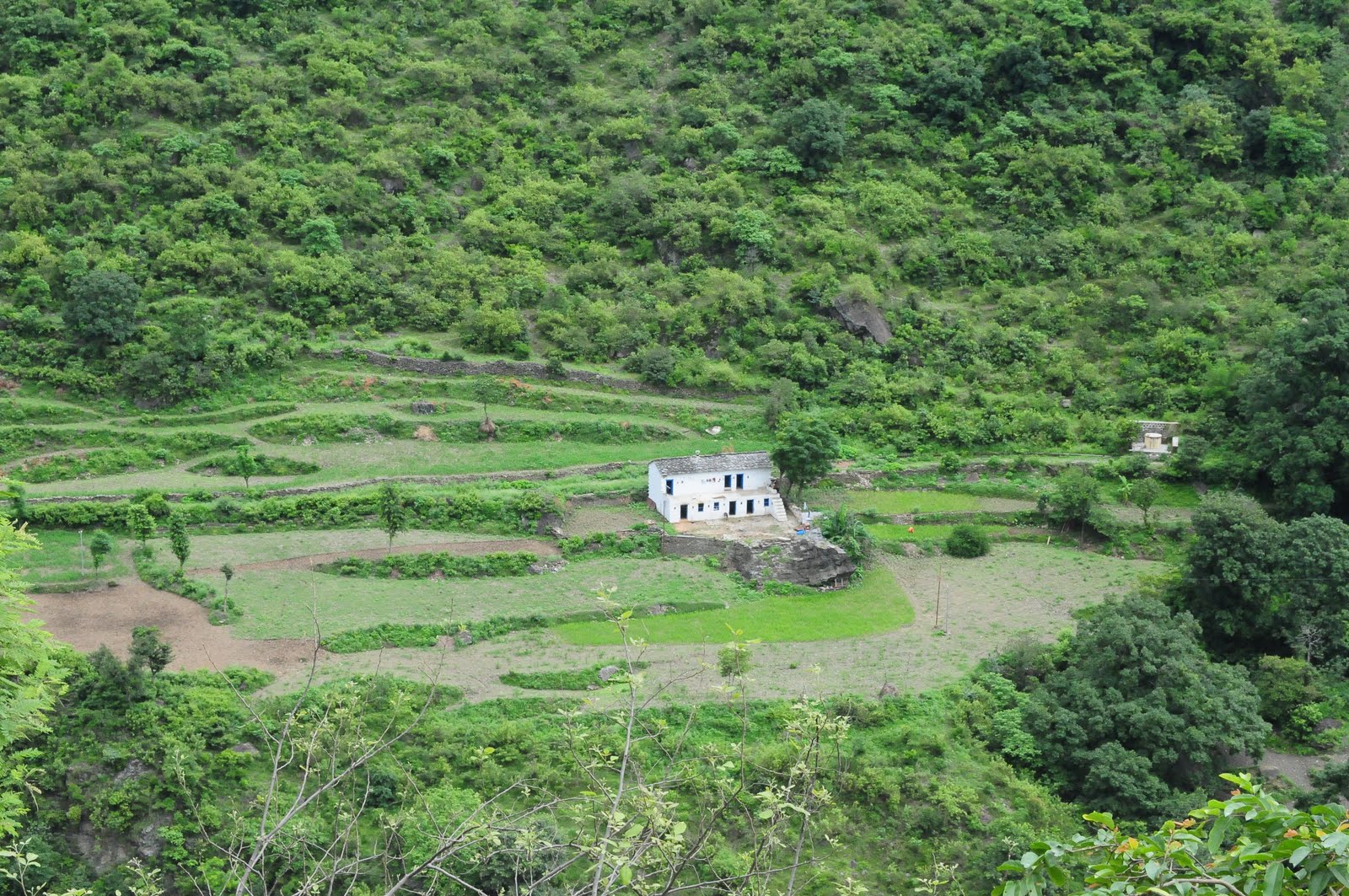
"Full many a ray of purest ray serene the dark unfathomed caves of ocean bear:
Full many a flower is born to blush unseen, and waste its sweetness to the desert air."
from "Elegy Written in a Country Churchyard" by Thomas Gray
Showing posts with label Mandakini. Show all posts

Saturday, July 9, 2011

Dwadashajyotirlinga yatra : Day 15 - Kedarnath - 2/2

We were at the mountain top. We would now need to walk about half a mile to the temple.


After the climb on the rocking pony walking on the edge of the path, coping with the sweat-drenched inner layers and the rain-drenched outer layers of clothing, getting on and off the pony for brunch, hoping the group reaches the temple safely, my mind was at peace now that we were at the top. The ponies were relieved to let the riders go, and turned to graze.

There was silence and serenity, and the intermittent chirping of the Himalayan birds added to the tranquility. Looking around at the ponies grazing on the gentle green slopes, the mist over the distant white and blue peaks, the white frothing streams on the black boulders, people in colorful clothes getting off ponies with equally colorful saddles, and the road ahead leading to the temple of Shiva, I had the sense of having arrived. The rain had now stopped, and I could breathe in the clean mountain air in a relaxed mood. There was a very welcome light breeze on my face, the only uncovered part of my body, other than my hands.

In retrospect, it was not a bright idea to wear three layers of clothing on top with the poncho being the fourth, and I felt really thankful that I did not wear a layer of clothing under my jeans. The weather has changed over the past few decades, and each year is hotter than the previous one - in the summer, I would recommend visitors to Kedar to wear a T-shirt and a light jacket with a poncho on top, and jeans and a single layer of socks, if you are a heat-resistant creature like me. People who feel cold easily, should add a layer to the above.  


We had left the ponies near some shops. The pony driver showed me the name of the shop and told me to show up here after visiting the temple, he would be waiting for me. I gave him some money for food, and to feed the horse. We had been asked by Swamiji to spend no more than an hour and a half at the temple, and return in time to start our descent.


Just as we entered the temple town, we walked a few yards and then crossed the bridge. The ferocity of the Mandakini splashing through rocky terrain needs to be seen to be believed. The clean flow of mineral water from the glaciers over the huge dark boulders makes for a spectacular visual. There was a light mist over the river, that gave a very period look to the view.  Kedarnath is a land beyond time, and very dear to me because this is the place where I had first become conscious of the powerful and active presence of Shiva years ago.


After crossing the bridge, there were steep steps - maybe 30 or so, and then a short steep climb to reach the temple town. After this, we walked through the narrow streets to reach the temple.


A street turn away from the temple, again the icon of Kaal Bhairav, looking me in the eye...

As I turned into the main temple street, the temple of Kedarnath was in full view - this had to be my most emotional moment in the trip, I had waited many years for this.

The Pandavas, on the advice of Krishna, were looking for Shiva's forgiveness for the sins of fratricide and killing of Brahmins, after the war of Mahabharata. They spotted Shiva, who took the form of a bull and vanished (became gupta) into the ground, at the place now known as Guptakashi. The hump of the bull surfaced on the ground, and the irregular rock formation is now worshipped as the shivalinga. The Pandavas built the temple around it, now known as Kedarnath - the lord of Kedar. Kedarkhand is the ancient name of Garhwal - now broken into the districts of Pauri Garhwal (the foothills) and Tehri Gahrwal (the valley). The temple stays open from the Hindu month of Vaisakh and closes on the first day of the Hindu month of Kartik - one can visit Kedarnath between May and November. During the winter months, the worship rituals are continued at Ukhimath.

The current temple, at a height of 3580 meters above sea level, is believed to be more than a thousand years old. It is built from stone slabs on a large rectangular platform. The sanctum sanctorum looks older than the main temple, and the entrance has inscriptions in Pali. Unfortunately, no photography is allowed here, as with all other temples. But here more than any other place on earth, I miss not being able to capture all the visuals. The main temple has the statues of the Pandavas, Krishna and Nandi carved into the walls. Outside the temple is a large statue of Nandi, looking at Kedarnath with devotion. The temple has been renovated over the centuries.

When Adi Shankaracharya visited Kedarnath, he revived the temple and initiated traditional ritualistic worship. He is believed to have attained samadhi near the temple, and there is a memorial in his name behind the temple. It is believed that Pandu, the father of the Pandavas, had died close to this place. And the Pandavas themselves left earth in the area behind this temple - known as Svargarohana. There are beautiful trekking paths behind Kedarnath, and it is my dream to spend a week here at some point in my life. Another trip, another time, Shiva's will...    

As our small group of parents and children arrived at the temple, we were not sure where to leave our footwear before entering the temple. Sarveshanandaji was in the temple complex, and asked us to follow him to a shop from where we got a steel plate each with the material for worship. He would stay there with everyone's backpacks and shoes while we went to the temple with Vinayakji. We went through the security gate at the temple, and then performed the abhishek - annointment. At the end of the ritual, Ashverya and I touched our heads to the shivalingam, our worship completed at the twelfth jyotirlinga temple. 

As I came out of the temple, Anantanandaji had just come there with a group of people. He had a large glass jar of ghee - clarified butter. I followed him back into the temple. It is believed that the Pandava, Bhima, massaged Shiva with ghee - clarified butter, and the worship of the shivalingam is traditionally performed with ghee. We may have put as much, if not more ghee on the lingam than Bhima had applied. All the questions I had, the clarifications I had asked at Shrishailam two weeks ago, were answered at Kedarnath. The answer may not be what my mind wants it to be, but acceptance brings peace, there is no arguing with Shiva. 

Vinayakji took us to the memorial of Adi Shankaracharya behind the temple. After this, I performed a hurried parikrama - three circumambulations, around the temple with Ashverya, and then we went back to claim our backpacks and shoes. Not just my feet, but my face and hands were swollen as well. My rings stayed stuck an inch short, on my fingers.  And now, we had to begin our journey down. Anantanandaji suggested walking on the way down. Going down on pony wreaks havoc on the back. Walking wreaks havoc on knees, but it is the easier option.

We started walking down around 2 in the afternoon, and reached after 6. In the nine miles that we walked, we had three breaks for chai, and each time the pony driver, who was hovering close by, would come and offer us a pony ride. The children were walking down as well, and they were in no hurry. After half the journey, they agreed to their pony driver's requests to get on the pony. Ashverya came to me to learn how she could tell her pony driver in Hindi that his pony wanted him to be more affectionate.

I was not in good health, but I would have managed nine miles, except that all nine miles are downhill. Ashverya's easy laugh lightens every moment, and when she was not walking with me any more, I was aware of my physical pain. 

I managed seven miles somehow, but the last two miles appeared to stretch forever. At some point, the pain in my knees could be ignored, and as I stood by the side of the mountain, I saw my leg muscles in involuntary spasm. I remember hoping that I would not fall down because I would not be able to get up. It is my usual practice to chant Aum Namaha Shivaaya as I breathe out, and stay silent as I breathe in. The pain was so deadening that I tried what Anantanandaji had suggested to me a week ago - chanting Hari as I breathe in, and OM as I breathe out. This would not allow a moment when my mind could waver. The frenetic chanting surprisingly brought about a mental silence till I saw a signboard that said there was one mile to go to the base. One more mile? ARE YOU KIDDING ME????? I do not have much to say about that last mile because my memory is lost in a fog of pain.

When we reached the foot of the mountain, our cars were waiting - the children on pony had reached before us, the parents were the last to arrive. Vinayakji was waiting for us, though he had been among the first to reach the bottom of the slope. He had passed us midway on the slopes, and he had vanished down the slopes. The car would take an hour to get back to the campgrounds, that I again spent in deep sleep. I do remember the extreme misery as I hauled myself on the stairs up to the dining hall. There was no yogurt, so no rice and yogurt dinner for me. I drank a cup of mixed vegetable soup, and limped back to my tent. I peeled off layers of wet clothing, and left them to hang by the side of the tent. There was no hot water, nor did I have the energy to go out and ask the attendants to start the water heater. I took a bucket bath in the cold water, and went to sleep after taking some Advil. At some point, the little god came back from her dinner, and went to sleep as well. Tomorrow is another day.

Kedar, again after seven years... Hope to be here again soon.

Aum Namaha Shivaaya!!  


Friday, July 8, 2011

Dwadashajyotirlinga yatra : Day 14 - Travel from Haridwar to Guptakashi

At 6 in the morning, the train stopped at Haridwar. And the group managed to get out of the train in record time.

At long last, we had set foot in the state of Uttarakhand, devbhoomi - land of the gods, and the land of my ancestors. I hope that I am sufficiently blessed to be able to visit each year.   


A peaceful scene of cows greeted us outside the railway station. We had to wait for the last car to arrive before our group could get into cars. We needed to get to the hotel to change and have breakfast, before we set off for Guptakashi. We have so far seen 11 jyotirlinga, and Kedarnath would be our last temple on this trip.


The hotel at Haridwar was a pleasant surprise. I had always thought of Haridwar as a small pilgrimage place. It was a relief to find a luxury hotel. We would be back here in three days after the visit to Kedarnath. As we prepared to travel, Ashverya and I realized something - we would be traveling the whole day in cars, and we could be in everyday clothes, translation - no sari or salwar kameez. Not that we don't love dressing up, but hey, jeans are jeans and shorts are shorts.


One of the ancient names of Haridwar, as cited in the Mahabharata, is Gangadwar - the door of the Ganga. This is the place from which the holy Ganga leaves the mountains and flows into the plains. We had already visited Nashik and Ujjain, where drops of nectar had fallen during the legendary battle for immortality between the divine beings and the unholy ones. Haridwar is the third of four locations where the drops of nectar had fallen. The fourth place is Prayag, that is not on our itinerary for this trip. Another trip, another time, Shiva's will... The exact spot where the nectar fell at Haridwar is the ghat - banks, known as Har ki Pauri - footsteps of the Lord.

View of Hrishikesh across the Lakshman Jhoola
We were off in cars to Guptakashi, having had our first sighting of the holy Ganga. It is usual to see hundreds of people, that become thousands on auspicious days, dipping in the river known as the Bhagirathi, brought down to earth by king Bhagiratha to purify the ashes of his ancestors. This story is re-lived on a daily basis by thousands of people who come to Haridwar after the cremation of their family members to immerse the ashes in the Ganga.

The sage Agastya had performed penance here with his wife Lopamudra, whose image we had seen in front of the Devi temple at Shrishailam ten days ago.  Haridwar is also known as Maya, and cited as one of the seven holy spots for the followers of Sanatana Dharma to attain salvation.

Seven years ago, we had come to Haridwar before our Char Dham yatra - piligrimage to the four abodes of divinity. The Char Dham in the state of Uttarakhand are: Gangotri - the source of the Ganga, Yamunotri - the source of the Yamuna, Kedarnath - the temple of Shiva, and Badrinath - the temple of Vishnu. As the earth has been warming up and the glaciers have been receding for decades now, the source of the Yamuna is now three miles north of Yamunotri, and the source of the Ganga is now at Gaumukh, nine miles north of Gangotri. 

About ten miles from Haridwar is the town of Hrishikesh. Hrishikesh means the lord of the senses in Sanskrit. It is named for Vishnu who is said to have appeared here to bless the sage Raibhya. By law, the town is vegetarian and dry. There are two suspension bridges across the Ganga - Ram Jhoola and Lakshman Jhoola. There is a statue of Shiva here at Paramartha Niketan that I have wanted to visit. Another trip, another time, Shiva's will...

Also, Hrishikesh has a bungy jump site, the first in India, that Karan had just jumped from. I would have loved to jump as well, but this needed to wait for another time. We had a long journey ahead. Hrishikesh in the Haridwar district is surrounded by the twin districts of Pauri Garhwal and Tehri Garhwal - the foothills and the valley region respectively of Garhwal, which has been referred to as Kedarkhand in the scriptures.

Shivalik ranges
While the distances were not great, the speed of less than twenty miles an hour stretched the short distance into many, many hours. Nobody was complaining though, least of all me. The captivating natural beauty of the Shivalik ranges allowed us to look out any time in any direction at spellbinding scenery. The roadsigns add to the entertainment value - from the flirtatious "Be gentle on my curves" to simple facts like "Whisky is risky".

The driver of our car was a devout follower of Sanatana Dharma, and I made the hilarious discovery that I was the only Kshatriya - warrior in the car. If an opportunity of sacrifice arose, it would be my dharma - duty, to make the sacrifice. The driver corrected me - it is not your dharma to give life, it is your dharma to take lives to protect us. Touche! We had the most interesting conversation with the driver. He had worked for two years as a truck operator in the Gulf, and now as a cab driver, he was a part of the biggest revenue generator for Uttarakhand - the travel industry. He lamented the decline of faith practices among the followers of Sanatana Dharma.


We stopped along the way for chai. Madhukarji bought us one of the greatest joys of childhood. There was a person roasting bhutta - corn on the cob, on the side of the road.


We drove up along the Ganga to Devprayag, where the Ganga is formed by the confluence of two holy rivers - the Bhagirathi coming from Gangotri and the Alaknanda whose tributary Mandakini flows by Kedarnath. Devprayag is a border town in Pauri Garhwal (the foothills) - the home of my ancestors, bordering the district of Tehri Garhwal (the valley).  


As we drove past, both rivers were clearly visible as they merged, both muddy as they brought fertile soil down the mountains with the seasonal rains - the Bhagirathi on the left and the Alaknanda on the right in the photograph. 

The temple of Raghunathji can be seen in the upper part of the village.


Dog walking alone through the mountains, how and why do they travel alone?


My dream house, and somebody else owns it :)

Everyone is on the path to salvation


Mandakini on the left, Alaknanda on the right
Slightly more than an hour later, after touching the district of Pauri Garhwal, we had entered the district of Rudraprayag, and reached the town of Rudraprayag at the confluence of Mandakini and Alaknanda.

24 miles from Rudraprayag is the town of Guptakashi, where we were scheduled to stay at night.  
Green card check
We were stopped by the police for a "green card" check, said the driver. Immigration check?? Apparently, the green card is a summary information card that stores the driver's licence, car insurance and the like.
Shivalik ranges

Mandakini


Mountain streams by the roadside
A while later, we stopped for chai. We had been traveling north, up along the Mandakini, towards its source, the Charabari glacier, close to Kedarnath. The Mandakini first meets with the Vasukiganga at Sonprayag, and flows south till it loses its identity after meeting the Alaknanda in Rudraprayag that we had just passed. The Alaknanda goes on to meet the Bhagirathi that flows from the Gaumukh glacier and forms the Ganga at Devprayag that we had seen this morning.

Step-farms by the Mandakini


Shivalinga in the furious flow of the Mandakini
As we stood in the balcony of the chai place, looking down at the fast-flowing river, I noticed this black boulder that was being washed by the Mandakini, and every once in a while, the water would flow over the head as well. If this was not a shivalingam, what is?  

We watched how the furious flow and the gigantic jagged boulders on the river floor make for reverse currents on the water surface, and it is impossible to tell which way the river is flowing.

Mandakini flowing from the right to the left, in this picture


An hour from Guptakashi campgrounds
Finally, there was a road sign where the road forks into the way to Guptakashi and to Ukhimath, the winter home of the deity at Kedarnath. On the right side of the photograph, the signboard talks about the wedding of Krishna's grandson Aniruddha with Banasura's daughter Usha, which is believed to have happened close to this spot.  

 King Banasura's daughter Usha had fallen in love with a man she saw in her dreams. Her friend, the minister's daughter, Chitralekha was an accomplished painter. She drew portraits of many kings and divine beings to help Usha identify the prince of her dreams. Finally when she drew the portrait of Krishna, Usha said there was a resemblance but it was not him. Then Chitralekha drew Krishna's son Pradyumna, and Usha said there was an even closer resemblance but it was not him. Finally Usha identified Pradyumna's son Aniruddha as the person she wanted to marry. With her knowledge of maya - illusion, Chitralekha kidnapped Aniruddha from Dwarka and brought him to Usha's palace where the lovers married and lived happily. When Banasura found out, he was enraged and made Aniruddha captive. Krishna attacked Banasura's kingdom to free his grandson. Shiva had blessed Bana with his protection, and a great battle was fought between Krishna's army and Shiva's forces. The story has a happy ending as Aniruddha took his bride home with blessings from all. There is an Usha Aniruddha temple in Ukhimath. Another trip, another time, Shiva's will... 

Guptakashi was now less than 20 miles away.

Guptakashi is a small town in the Mandakini river valley. After the war of the Mahabharata, on the advice of Krishna and elders, the Pandavas sought Shiva's blessings to be forgiven for the sins of fratricide and for killing Brahmins. But Shiva would not appear to them. It is believed that it was at Guptakashi that the Pandavas saw Shiva, and just as they identified him, he took the form of a bull to mix in the herd that was grazing there. Bhima tried to get hold of the bull who became gupta - vanished, by sinking into the ground. The spot became known as Guptakashi - it is one of the places that is believed to be equivalent in holiness to Shiva's city Kashi, or Varanasi where we were a couple of days ago. Shiva as the bull, later re-surfaced in five places in Uttarakhand - the face at Rudraprayag, the arms in Tunganath, the locks at Kalpeshwar, the hump at Kedarnath, and the navel and stomach at Madhyamaheshwar. All five places have beautiful Shiva temples that are worth visiting.

I must have dozed off because I remember hearing "we are here" and then looking up the steep steps at the campgrounds.
Just like the step-farms of Uttarakhand, the campgrounds had laddered mountain slopes where tents were pitched. The lowest rung was the dining hall, the next rung was assigned to people in our group who had difficulty walking, the middle rung had two tents one of which was mine, and the upper rung had the rest of the group.


I cannot imagine that anyone remembered at that time, that we had arrived at Haridwar railway station this very morning, that journey seemed so long ago. All minds were on the trek to Kedarnath tomorrow, the toughest access of all the Jyotirlingas.  

Sarveshanandaji took pictures of the exotic flowers around the place.


Dinner was served an hour later. After dinner, the Swamijis suggested that one of the group members should not come to Kedarnath, considering her age and general health. Kedarnath at a height of 14,000 feet does cause altitude sickness in some, and there are no hospitals or medical facilities along the way in case someone falls sick. Climbing mountains and visiting temples does not add to spiritual growth, it is the journey within. So unnecessary physical risks that could impact the travel plans of others in the group need to be taken with care. But the group member's daughter who was also traveling with us, had made up her mind, and wanted her mother to visit the temple. No amount of convincing from the Swamijis or others in the group would change her decision.


Kedarnath tomorrow...I knew I would come back here when I had visited 7 years ago, and finally I was at the feet of Kedar again, at Shiva's call.


Aum Namaha Shivaaya!!